
Lip Filler Melbourne: A Clinical Approach to Natural Lip Augmentation
September 14, 2026
Treating a hollow tear trough with traditional volume replacement may actually exacerbate the appearance of fatigue if the primary concern is cellular thinning rather than structural loss. You’ve likely found that even consistent sleep doesn’t resolve the persistent dark circles or the fine, crepey texture that often defines the periorbital zone. When considering injectables for under eyes, it’s vital to move beyond surface-level fixes and understand the specific biological requirements of your skin to avoid an unnatural or overfilled result.
This article provides an objective, clinical overview of prescription treatments to help you understand the critical distinction between physical volume restoration and biological skin regeneration. We will explore how advanced methods like Rejuran and exosome therapy interact with your body’s physiology to improve skin thickness and quality. By the end of this guide, you’ll have the technical insight needed to discuss a personalised treatment plan with an experienced practitioner, ensuring your results look natural and respect the unique anatomy of your face.
Key Takeaways
- Recognise the anatomical complexities of the periorbital region, where the body’s thinnest skin requires a highly specialised clinical approach.
- Distinguish between the immediate volume restoration of hyaluronic acid gels and the cellular-level repair offered by modern injectables for under eyes.
- Understand how diagnostic tools like the “Snap Test” identify lower eyelid laxity to ensure treatments are appropriate for your specific skin physiology.
- Evaluate the technical benefits of blunt-tipped cannulas in minimising trauma and enhancing safety within the intricate vascular network of the eye area.
- Learn how regenerative therapies such as Rejuran and exosomes focus on long-term skin quality and thickness rather than temporary structural filling.
Clinical Anatomy of the Periorbital Region
The periorbital region is biologically unique. Its dermal layer is remarkably thin, often measuring less than 0.5mm, which makes it the first area to exhibit signs of chronological and environmental ageing. A primary factor in the appearance of “hollowness” is the tear trough ligament. This fibrous attachment binds the skin and muscle to the underlying bone, creating a tethered indentation. When we discuss the Clinical Anatomy of the Periorbital Region, we must account for how these deep structures interact with the superficial skin.
The under-eye area doesn’t exist in isolation; it relies on the mid-face and malar region for structural scaffolding. When the cheek loses its projection, the support for the lower eyelid diminishes, leading to a visible descent of tissues. This often necessitates the use of injectables for under eyes to address the deficit and restore the smooth transition between the lower lid and the mid-face.
The Role of Facial Fat Pads and Bone Resorption
Ageing involves a predictable sequence of volume loss within the deep medial fat pads. As these compartments diminish, the smooth transition between the eyelid and the cheek is disrupted. Simultaneously, the orbital rim, which is the bony aperture of the eye socket, undergoes resorption. This process causes the socket to widen and recede, removing the platform upon which the soft tissue sits. Consequently, under-eye hollowing is rarely a surface-level problem. It’s a multi-layered anatomical shift involving:
- The reduction of deep fat pad volume that provides anterior projection.
- The recession of the maxillary bone, leading to a loss of structural foundation.
- The increased visibility of the tear trough ligament as surrounding tissues thin.
Pigment vs. Shadow: Diagnostic Clarity
Effective treatment requires a precise diagnosis of what the patient perceives as a “dark circle.” True pigmentary dark circles result from melanin deposition or vascular congestion, where blood pools in the capillaries beneath the thin skin. Conversely, structural shadows are an optical illusion caused by light refraction. When light hits the ridge of a hollow tear trough, it casts a diagonal shadow into the depression, mimicking the look of pigmentation.
A clinical skin analysis is essential to distinguish between these causes. If the darkness disappears when the skin is pulled taut or illuminated directly, the issue is structural. While vascular concerns might benefit from topical or laser interventions, structural deficits often require specific injectables for under eyes to restore light-reflecting surfaces and eliminate the shadow effect.
Therapeutic Modalities: Dermal Fillers vs. Bio-stimulators
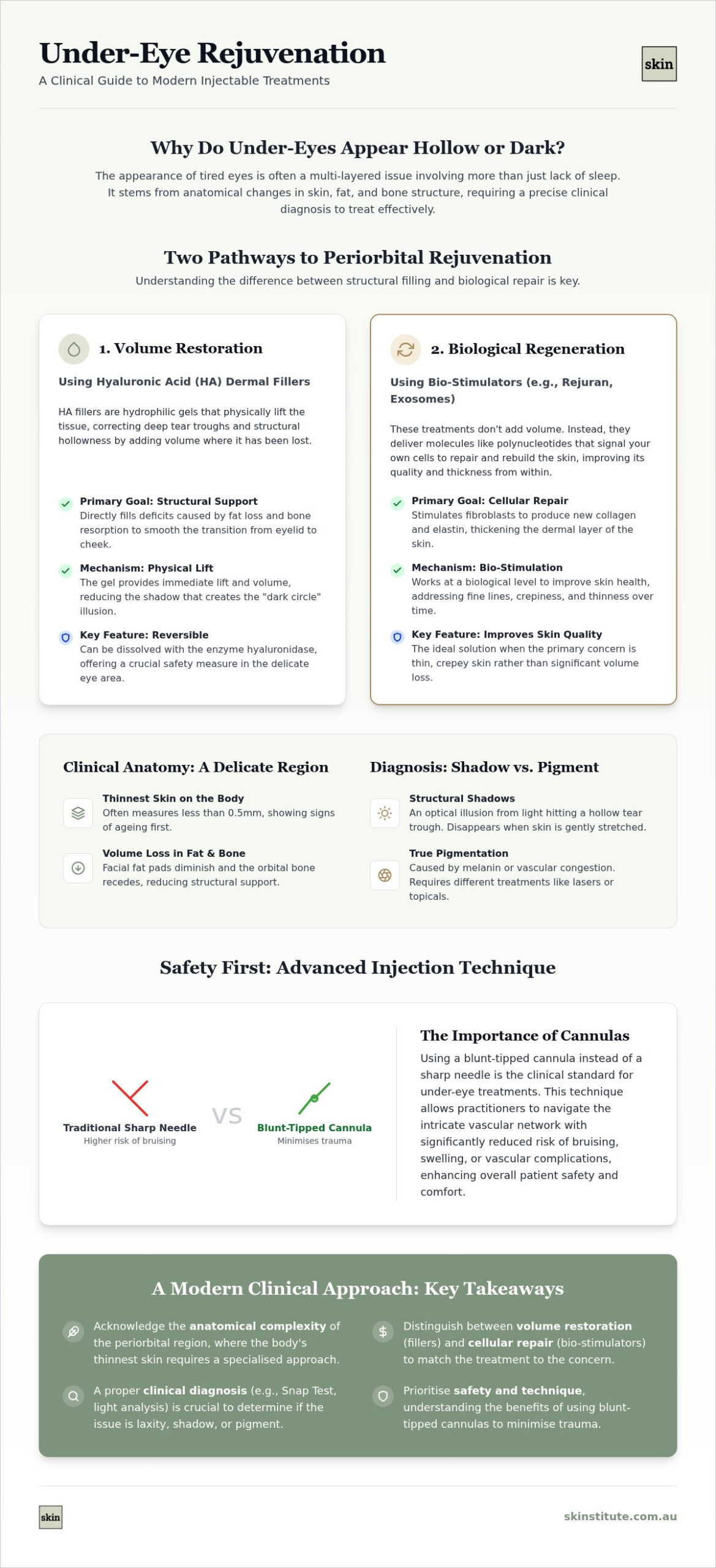
Periorbital rejuvenation has transitioned from a purely volumising focus to a sophisticated dual-pathway strategy. Clinical practitioners now distinguish between structural restoration via cross-linked gels and biological repair through regenerative molecules. Selecting the correct injectables for under eyes requires a precise assessment of whether the patient lacks physical volume or suffers from dermal thinning and poor skin quality. Each modality interacts with the tissue through distinct biochemical mechanisms to achieve specific aesthetic goals.
Hyaluronic Acid Fillers for Volume Restoration
Prescription dermal fillers composed of hyaluronic acid (HA) remain a primary tool for correcting deep tear trough deformities. These gels are hydrophilic, meaning they naturally attract and bind water to maintain volume within the tissue. In the delicate periorbital zone, clinicians typically select fillers with low hydrophilicity. This choice is critical to prevent post-procedural oedema, which can lead to persistent puffiness if the product absorbs excessive fluid from the surrounding area. To maintain dermal filler safety, HA-based treatments offer the benefit of being reversible. If a complication arises or the aesthetic result requires adjustment, the enzyme hyaluronidase can be injected to dissolve the gel immediately, providing a level of security that is essential when treating the eye area.
Regenerative Medicine: Rejuran and Exosomes
While fillers address shadows caused by hollowing, regenerative treatments focus on the biological integrity of the skin. Rejuran Melbourne utilise polynucleotides, which are DNA fragments derived from wild salmon, to stimulate fibroblast activity and increase the production of Type I collagen. This process thickens the dermis, making it an ideal solution for patients with fine lines or “crepey” texture. Exosome therapy complements this by delivering extracellular vesicles that contain potent signalling molecules. These vesicles facilitate intercellular communication, reducing local inflammation and accelerating tissue repair at a cellular level. These bio-stimulators are increasingly favoured for patients who desire a refreshed appearance without the addition of exogenous volume.
Choosing between these modalities depends on the primary anatomical concern. Patients with deep structural troughs but good skin elasticity are often better suited for HA fillers. Conversely, those exhibiting skin laxity or visible vascularity through thin skin may achieve superior results with bio-stimulators. In many cases, a multi-modal approach yields the most comprehensive outcome. You can explore these options further during a professional consultation at Skinstitute to determine which technology aligns with your specific biological requirements.
Clinical Suitability: Who is a Candidate for Under-Eye Injectables?
Determining clinical suitability for injectables for under eyes requires a rigorous assessment of tissue integrity and underlying anatomy. One primary diagnostic tool utilised during a consultation is the “Snap Test”. The practitioner gently pulls the lower eyelid skin downwards and observes the speed of its return to the neutral position. A slow recoil indicates significant skin laxity or a weakened orbicularis oculi muscle. In these instances, adding volume through traditional fillers may cause the tissue to sag further or lead to persistent fluid retention. Patients with high skin elasticity and clear structural hollowing are typically the most appropriate candidates for volumising treatments.
Certain anatomical conditions, such as malar bags or festoons, serve as a critical warning for practitioners. Malar bags are chronic fluid accumulations or fat protrusions located on the cheekbone, distinct from the tear trough. Because many injectables for under eyes involve hydrophilic gels that attract water, injecting them into a patient prone to lymphatic congestion will likely exacerbate the puffiness. These patients are often better suited for regenerative treatments like Rejuran or specialised skin-tightening modalities that do not add exogenous volume. When the hollowing is accompanied by significant fat prolapse, commonly known as “eye bags”, injectables reach a therapeutic limit, and a surgical referral for a blepharoplasty may be the most effective clinical pathway.
The Importance of Mid-Face Support
Periorbital rejuvenation often begins with the mid-face rather than the eye itself. The tear trough is frequently a secondary symptom of malar fat pad descent. By restoring volume to the lateral and medial cheek, a practitioner provides an indirect lift to the lower eyelid. This approach creates a seamless transition and often reduces the amount of product needed directly in the infraorbital area. Addressing the face as a holistic system ensures a balanced contour and avoids the unnatural appearance that occurs when the eye area is treated in isolation. This structural scaffolding is essential for achieving a refreshed, rested look that respects the patient’s natural features.
Contraindications and Risk Assessment
Safety remains the priority in any medical-grade procedure. Clinical reasons to defer treatment include active infections at the injection site, systemic autoimmune conditions, or a history of severe allergies. A thorough review of medical history is vital to mitigate the risk of vascular events, ensuring the practitioner can map the periorbital vasculature accurately. Managing expectations is also a key component of the consultation, particularly for patients with significant fluid retention or systemic health issues that may affect healing. A seasoned practitioner prioritises safety and evidence-based results over immediate aesthetic changes, ensuring that every treatment plan is grounded in clinical necessity.
The Treatment Journey: Safety, Technique, and Aftercare
Every procedure involving injectables for under eyes begins with a meticulous clinical assessment, a mandatory requirement under current Australian health regulations. This stage involves mapping the patient’s unique periorbital vasculature to identify high-risk arterial zones. A seasoned practitioner uses this time to establish realistic physiological goals, ensuring the proposed volume or regenerative treatment aligns with the patient’s existing anatomy. To ensure comfort, a high-potency topical anaesthetic is applied; the prescription injectables themselves often contain integrated lidocaine to provide immediate local relief during the delivery of the product.
Cannula vs. Needle: A Safety Perspective
The choice of delivery instrument is a critical safety consideration in periorbital rejuvenation. While sharp needles allow for high precision, they carry an increased risk of piercing blood vessels in the crowded infraorbital space. Blunt-tipped cannulas are frequently the preferred instrument for several clinical reasons:
- They tend to push vessels aside rather than puncturing them, significantly reducing the incidence of bruising and haematoma.
- The length of the cannula allows for the product to be placed through a single entry point, minimising tissue trauma and the risk of infection.
- They facilitate the precise deposition of the product in the deep sub-orbicularis plane, providing a natural buffer between the injectable and the surface skin.
This technical approach is paramount in avoiding intravascular injection, a rare but serious complication that requires immediate clinical intervention. By prioritising the use of cannulas, practitioners can achieve smoother results with a significantly enhanced safety profile.
Recovery Timeline and Clinical Aftercare
Post-procedural recovery is typically predictable but requires adherence to specific clinical guidelines. Immediately following the session, patients may experience mild oedema or pinpoint bruising at the entry site. These effects generally resolve within 48 to 72 hours. The integration phase lasts approximately 14 days, during which the injectable settles into the surrounding facial tissues and achieves its final aesthetic position. A follow-up review at the two-week mark allows the practitioner to evaluate the symmetry and integration of the treatment.
Long-term maintenance of the periorbital area involves a synergistic approach. Results are best preserved through daily application of broad-spectrum SPF 50+ to prevent UV-induced collagen degradation and the use of medical-grade topical antioxidants to support skin barrier function. Patients should avoid vigorous exercise or high-heat environments, such as saunas, for the first 48 hours to limit swelling. If you are considering a periorbital treatment, you can book a clinical consultation with the experienced team at Skinstitute to ensure your journey is managed with the highest professional standards.
The Skinstitute Melbourne Approach to Eye Rejuvenation
Skinstitute Melbourne operates with a philosophy grounded in over 26 years of clinical experience. This extensive tenure allows our practitioners to navigate the complexities of periorbital anatomy with a level of technical proficiency that ensures both safety and aesthetic precision. We don’t view periorbital rejuvenation as a generic application of product; rather, it’s a bespoke medical intervention designed to address the specific physiological changes unique to every individual. By focusing on the biological requirements of the tissue, we ensure that every treatment supports the skin’s long-term health while restoring its youthful characteristics.
Achieving optimal clinical outcomes often requires a multi-modal strategy that addresses multiple layers of the dermis. While injectables for under eyes are highly effective for restoring lost volume or improving dermal thickness, they are frequently integrated with advanced technologies to address surface-level laxity. For instance, Fractional CO2 Laser Resurfacing Melbourne provides a critical tool for skin contraction and collagen remodelling. By combining these modalities, we can treat both the structural hollows and the superficial “crepiness” that often coexist in the eye area, leading to a more comprehensive and refined result.
Comprehensive Periorbital Assessment
Every patient journey at Skinstitute begins with an exhaustive clinical skin analysis. This diagnostic phase is essential to identify whether the primary concern is structural volume loss, dermal thinning, or pigmentary changes. We prioritise patient education throughout this process, ensuring that informed consent is based on a thorough understanding of the biological mechanisms involved. This collaborative approach allows us to tailor a plan that might involve a combination of injectables for under eyes, bio-stimulators, or laser therapies. By understanding the “why” behind every procedure, you can feel confident in the precision of your treatment plan.
Safety Standards and Professional Integrity
Our commitment to safety is reflected in our adherence to rigorous clinical protocols and TGA-compliant practices. We recognise that the periorbital zone is an anatomically high-risk area, requiring advanced injection techniques and a deep understanding of the underlying facial vasculature to avoid complications. Our practitioners engage in continuous professional development to maintain mastery over evolving aesthetic technologies and safety standards. We value professional integrity and evidence-based results, ensuring that every recommendation is focused on achieving a refined, natural appearance that respects your facial structure. If you are ready to discuss your periorbital concerns with a seasoned expert, you can book a clinical consultation at Skinstitute Melbourne.
Refining Your Periorbital Rejuvenation Strategy
Successful under-eye rejuvenation relies on a precise diagnostic approach that distinguishes between structural hollowing and the biological thinning of the dermis. As we’ve explored, the transition from a fatigued appearance to a refreshed one involves selecting the correct modality, whether that be restoring volume with hyaluronic acid or stimulating cellular repair with polynucleotides. Understanding these anatomical requirements is the first step toward achieving a natural result that integrates seamlessly with your facial features.
With over 26 years of medical aesthetic experience, Skinstitute specialises in advanced bio-stimulators and regenerative medicine, prioritising clinical safety above all else. Our practitioners act as your clinical guide, ensuring that every application of injectables for under eyes is grounded in technical mastery and scientific integrity. We invite you to Book a Clinical Consultation at Skinstitute Melbourne to begin a bespoke treatment journey tailored to your specific physiological needs. We look forward to helping you achieve a rested and revitalised appearance through evidence-based care.
Frequently Asked Questions
How long do under-eye injectables typically last?
The longevity of results varies according to the specific technology utilised and the patient’s metabolic rate. Hyaluronic acid gels typically provide structural support for nine to twelve months in the periorbital region. Regenerative treatments like Rejuran often involve an initial series of three sessions to stimulate collagen, with subsequent maintenance recommended every six to twelve months. During your consultation in Melbourne, we assess your tissue integration to provide a more accurate expectation of duration.
Is the procedure painful, and what anaesthetic options are available?
Most patients report minimal discomfort during the procedure. We utilise a high-potency topical anaesthetic to numb the entry points before the treatment begins. Additionally, many prescription injectables for under eyes are formulated with integrated lidocaine, which provides immediate local relief as the product is delivered into the tissue. The use of blunt-tipped cannulas further reduces the sensation of pressure and trauma compared to traditional needle techniques, ensuring a more comfortable experience.
What is the “Tyndall effect” and how can it be avoided?
The Tyndall effect is an optical phenomenon where light scatters through a transparent substance, creating a persistent blueish tint under the skin. This typically occurs when hyaluronic acid fillers are placed too superficially or if the incorrect gel density is selected for the thin periorbital dermis. To avoid this, our Melbourne practitioners prioritise deep placement beneath the orbicularis oculi muscle and select products with specific rheological properties that integrate seamlessly without altering light refraction.
Can under-eye fillers cause blindness, and what are the safety protocols?
While extremely rare, vascular occlusion leading to vision loss is a recognised risk of facial injections. Safety is our primary priority; we employ advanced protocols such as anatomical mapping and the use of blunt-tipped cannulas to avoid arterial trauma. Every procedure is performed by a practitioner with extensive clinical experience who has immediate access to hyaluronidase, the enzyme required to dissolve hyaluronic acid fillers in the event of a vascular emergency.
What is the difference between tear trough fillers and Rejuran for under eyes?
The primary difference lies in their mechanism of action. Traditional tear trough fillers utilise hyaluronic acid to physically replace lost volume and eliminate shadows caused by hollowing. In contrast, Rejuran consists of polynucleotides that repair skin at a cellular level, stimulating collagen production to thicken the dermis. While fillers provide an immediate structural change, Rejuran focuses on long-term skin health and is often preferred for treating fine lines and crepey texture without adding exogenous volume.
How much downtime should I expect after an under-eye injectable treatment?
Most patients experience minimal downtime and can return to their daily activities immediately. You should expect mild swelling or oedema for the first twenty-four to forty-eight hours as the product integrates with the tissue. Pinpoint bruising at the entry site is possible, though the use of cannulas significantly reduces this risk. We recommend avoiding vigorous exercise or high-heat environments like saunas for two days following your treatment at our Melbourne clinic to ensure optimal healing.
Can I have under-eye injectables if I have significant eye bags?
Patients with significant fat prolapse, commonly known as eye bags, are often poor candidates for volumising treatments. Adding hydrophilic injectables for under eyes to an area already prone to puffiness can exacerbate the appearance of the bags by attracting further fluid. In these cases, we may recommend regenerative treatments like exosomes to improve skin tension or suggest a surgical referral for a blepharoplasty if the anatomical protrusion exceeds the limits of non-invasive correction.
Are the results of under-eye injectables reversible if I am unhappy?
Results achieved with hyaluronic acid fillers are fully reversible through the administration of hyaluronidase, an enzyme that dissolves the gel within hours. This provides an important safety net for patients who are unhappy with their aesthetic outcome or require adjustment. However, regenerative treatments such as Rejuran or exosomes are not reversible in the same manner, as they stimulate the body’s own biological repair processes. These results settle gradually and naturally as the skin’s quality improves over time.