Prescription Injectables for Facial Contouring in Melbourne
June 10, 2026
Skinstitute Melbourne: A Clinical Guide to Medical-Grade Aesthetic Treatments
June 12, 2026
The most effective aesthetic outcomes are rarely the result of simply ‘filling’ a crease, but rather the consequence of precise anatomical restoration. It’s common to feel overwhelmed by the technical distinctions between various prescription substances or to feel anxious about the possibility of looking unnatural. When researching cosmetic injectables Melbourne patients often prioritise safety and a refreshed appearance that respects their underlying bone structure. You likely recognise that a conservative, evidence-based approach is essential for achieving a result that looks like you, only more rested.
This guide offers a clinical overview of what to expect during your appointment, moving beyond marketing terminology to explain the biological mechanics of volume loss and dermal structural support. We’ll examine the rigorous standards governing Schedule 4 substances and the role of bio-stimulators in long-term tissue health. You’ll gain a clear understanding of how professional practitioners utilise medical-grade protocols to achieve facial harmony and reduced dynamic wrinkles through technical mastery.
Key Takeaways
- Understand why modern clinical standards in Victoria have shifted from simple line-filling to comprehensive anatomical harmonisation for natural-looking results.
- Learn the biological mechanisms behind prescription substances, including how muscle relaxants and cross-linked dermal fillers interact with facial physiology.
- Discover how practitioners of cosmetic injectables melbourne utilise strategic volume restoration techniques, such as the ‘Liquid Lift’, to provide structural support to the mid-face.
- Identify the critical safety requirements for your appointment, including the role of the consulting physician and compliance with AHPRA’s latest guidelines.
- Learn how integrating regenerative treatments like Rejuran or exosomes can enhance the results of your injectable plan by improving skin quality at a cellular level.
Understanding Clinical Standards for Cosmetic Injectables in Melbourne
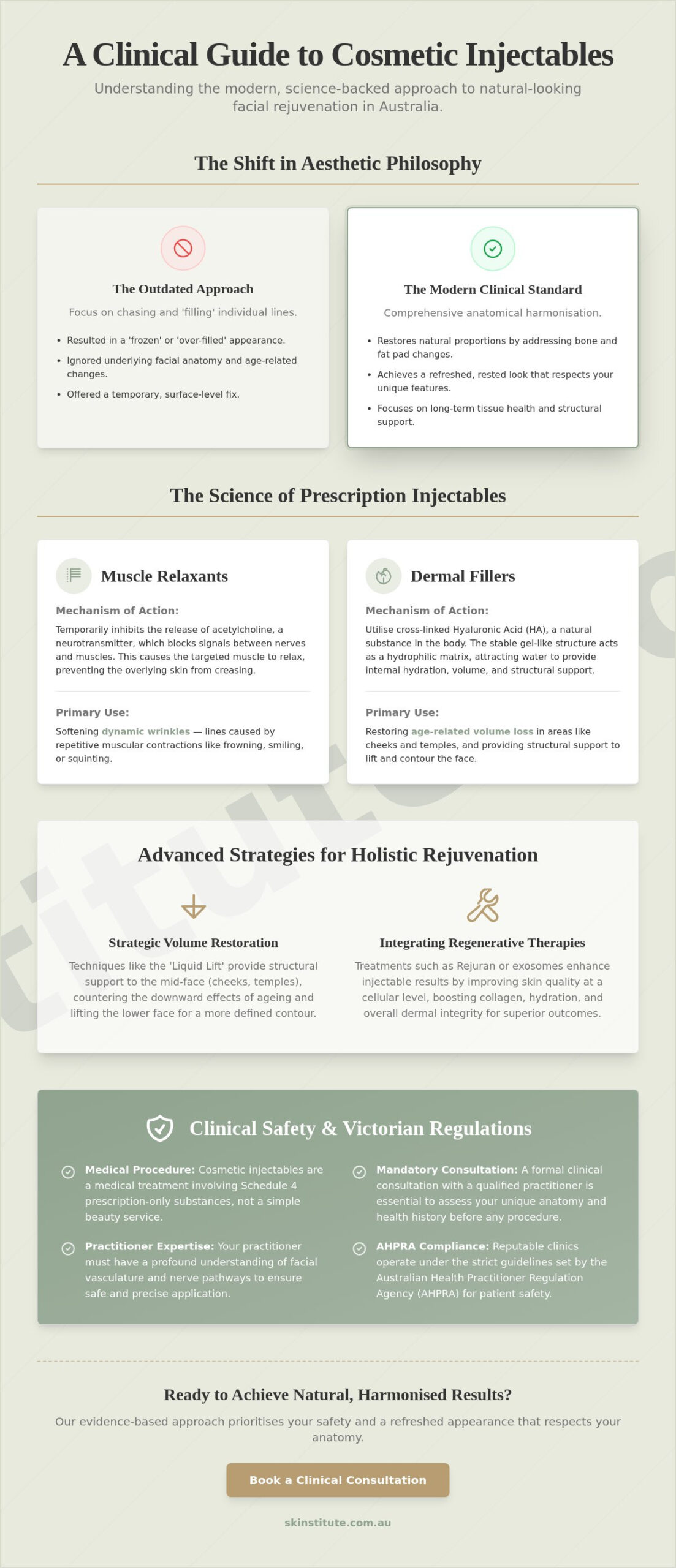
Cosmetic injectables aren’t merely beauty treatments; they are medical procedures involving Schedule 4 prescription-only substances designed for facial rejuvenation. In the context of cosmetic injectables melbourne practitioners must adhere to strict clinical standards to ensure patient safety and anatomical integrity. Historically, the aesthetic industry was often associated with a ‘frozen’ or over-filled appearance. Modern clinical practice has shifted decisively toward anatomical harmonisation. This approach focuses on restoring the face’s natural proportions by understanding how underlying structures, such as bone and fat pads, change as we age.
Achieving these subtle, restorative results requires a profound understanding of facial vasculature and nerve pathways. With 26 years of industry experience, a practitioner develops the technical proficiency required to navigate these complex biological systems safely. This expertise is vital when administering substances like Botulinum toxin, where precise placement determines the difference between a refreshed look and an unintended functional impairment. Every successful treatment trajectory begins with a formal clinical consultation to establish a baseline for your unique facial anatomy and health history.
The Distinction Between Retail Beauty and Medical Aesthetics
The rise of ‘discount’ clinics has led to a commoditisation of medical aesthetics, often at the expense of sterile protocols and practitioner experience. A clinical environment is essential for maintaining the high standards required for safe injectable procedures. In Victoria, the ‘medical-grade’ designation signifies that the clinic operates under the supervision of qualified medical professionals who prioritise long-term physiological health. Choosing a clinical setting ensures that the products used are sourced through legitimate pharmaceutical channels and stored under precise conditions to maintain their molecular stability and efficacy.
Identifying Your Primary Aesthetic Concerns
Effective rejuvenation requires a clear distinction between age-related volume loss and dynamic expression lines. Volume loss typically occurs in the mid-face and temples as fat pads diminish, which requires structural support rather than surface-level filling. Conversely, dynamic lines are the result of repetitive muscular contractions. Melbourne’s high UV index and fluctuating climate often accelerate the degradation of collagen and elastin, leading to premature skin ageing. A clinical assessment identifies these specific concerns, allowing for a targeted plan that addresses:
- Structural support: Restoring lost volume in the cheeks or temples to lift the lower face.
- Muscle modulation: Softening the contractions that cause permanent etching in the skin.
- Dermal integrity: Improving the skin’s biological ability to retain moisture and elasticity.
The Biological Mechanism and Science of Prescription Injectables
The efficacy of modern aesthetic medicine relies on the precise interaction between pharmaceutical agents and human physiology. When administering cosmetic injectables melbourne practitioners select specific substances based on their molecular weight and biological function. Muscle relaxants work by temporarily inhibiting the release of acetylcholine, the neurotransmitter responsible for signal transmission between nerves and muscles. By blocking these signals, the targeted muscle enters a state of relaxation, which prevents the mechanical folding of the skin that leads to dynamic wrinkling. This process is highly localised, allowing for the softening of expression lines without affecting the surrounding facial architecture.
Dermal fillers operate through a different mechanism, primarily utilising hyaluronic acid (HA), a naturally occurring polysaccharide in the human connective tissue. To ensure longevity, these HA molecules undergo a process called cross-linking, which creates a stable gel-like structure resistant to rapid enzymatic degradation. This substance acts as a hydrophilic matrix, attracting and binding water molecules to provide internal hydration and volume. Understanding how cosmetic injectables work at this cellular level is essential for managing expectations regarding metabolisation. It’s a physiological reality that every substance is eventually broken down by the body’s natural enzymes, such as hyaluronidase, which is why a structured maintenance programme is necessary for those utilising cosmetic injectables melbourne.
Prescription-Only Status: Why it Matters for Your Safety
In Australia, the substances used in these procedures are classified as Schedule 4 medicines. This legal classification means they can’t be purchased over-the-counter and require a formal prescription from a registered medical practitioner. This regulation ensures that every patient undergoes a clinical assessment to determine the therapeutic need and suitability of the treatment. Unlike topical ‘fillers’ found in retail skincare, prescription injectables penetrate the dermal and sub-dermal layers to effect physiological change. This medical oversight is a non-negotiable standard for anyone seeking safe clinical outcomes in Victoria.
Hyaluronic Acid vs. Bio-Stimulatory Agents
While HA fillers provide immediate volume replacement by physically occupying space, bio-stimulatory agents work by encouraging the body’s own regenerative processes. These agents trigger the production of type I and type III collagen and elastin, leading to long-term structural improvement in skin density. Many patients now opt for rejuran melbourne treatments, which utilise polynucleotides to repair skin at a cellular level. These DNA-derived fragments are particularly effective for addressing the thin, crepey skin often seen in the peri-orbital area, providing a foundation of health that complements traditional volume restoration and anatomical contouring.
Strategic Volume Restoration and Facial Contouring Techniques
Clinical mastery in the field of cosmetic injectables melbourne is defined by the ability to restore lost structural support rather than merely masking surface imperfections. As facial ageing progresses, the depletion of deep fat pads and bone resorption leads to a downward shift of the overlying soft tissues. A strategic approach involves the ‘Liquid Lift’ protocol, which utilises prescription injectables melbourne to re-establish the foundation of the face. By placing high-viscosity clinical products deep against the periosteum, a practitioner can achieve a subtle lift that mimics the natural skeletal structure. This method prioritises anatomical precision over volume, adhering to a ‘less is more’ philosophy that prevents the distorted, over-filled appearance often seen on social media platforms.
Addressing the ‘tear trough’ and periorbital area requires a particularly sophisticated level of technical proficiency. The skin in this region is the thinnest on the human body, meaning any product placement must be exact to avoid visible irregularities. Using clinical products with specific rheological properties allows for the correction of hollows while maintaining a seamless transition between the lower eyelid and the cheek. This focus on profile harmony ensures that the results are visible yet indistinguishable from the patient’s natural features.
Mid-Face Restoration: The Foundation of Youthful Contours
The mid-face serves as the structural anchor for the entire visage. Restoring the ‘Triangle of Youth’, where the widest point of the face resides at the cheekbones and tapers to the chin, is a primary goal of anatomical restoration. Strategic cheek augmentation doesn’t just enhance the malar region; it provides a mechanical lift that naturally reduces the appearance of nasolabial folds. The success of this technique depends on the clinical selection of filler thickness. High-G-prime gels are used for deep structural support, while softer, more cohesive gels are reserved for superficial layers to ensure natural movement during facial expressions.
Lower Face Contouring and Jowl Management
Addressing the lower face requires a nuanced understanding of how the jawline and chin contribute to profile harmony. For patients experiencing significant skin laxity, it’s important to consider hifu vs thread lift for jowls melbourne as potential adjuncts or alternatives to injectable treatments. However, fillers remain a gold standard for defining a sharp, medically-refined jawline. Additionally, masseter injections can be utilised to slim the lower face while simultaneously managing bruxism by reducing the force of the jaw muscles. This dual-purpose application demonstrates the intersection of functional health and aesthetic refinement.
Clinical Safety: Navigating Regulations and Practitioner Expertise in Victoria
Patient safety within the Victorian aesthetic sector is governed by rigorous standards set by the Australian Health Practitioner Regulation Agency (AHPRA) and the Medical Board of Australia. When seeking cosmetic injectables melbourne patients must ensure their clinic adheres to the updated 2025 guidelines, which mandate a comprehensive informed consent process and a clear therapeutic justification for every procedure. A critical component of this regulatory framework is the role of the ‘Consulting Physician’. In Victoria, Schedule 4 substances cannot be administered without a real-time consultation, either in person or via video, with a registered prescriber. This ensures that a medical professional has reviewed your health history and validated the clinical necessity of the treatment.
While minor side effects like localised bruising or oedema are common physiological responses to injection, more significant complications require immediate clinical intervention. Vascular occlusion, though rare, is a serious event where a substance inadvertently enters a blood vessel. Managing such an incident requires a practitioner with an exhaustive knowledge of facial vasculature and immediate access to emergency reversal agents. This is where 26 years of clinical experience serves as the ultimate safety net. A seasoned practitioner possesses the diagnostic skills to identify early warning signs and the technical proficiency to resolve them promptly.
The Importance of Post-Treatment Clinical Aftercare
Recovery timelines vary, but most patients experience a resolution of initial swelling within 24 to 48 hours. Clinical protocols for managing inflammatory responses or minor asymmetries involve scheduled follow-up assessments to ensure the substance has integrated correctly with the host tissue. Access to your clinical team is essential during this period for peace of mind and professional guidance. For those prioritising medical-grade safety and professional oversight, you can book a clinical consultation to discuss a personalised treatment trajectory.
Red Flags When Choosing a Melbourne Injector
Identifying a safe clinical environment is paramount for avoiding adverse outcomes. Non-clinical settings, such as ‘home-visit’ services, lack the sterile conditions and emergency equipment required for medical procedures. To verify a practitioner’s credentials, patients should consult the AHPRA public register to confirm their current registration and any historical conditions on their practice. Be wary of clinics that focus heavily on ‘unit’ pricing. This commercial approach often prioritises volume sales over clinical necessity, potentially leading to over-treatment and the ‘over-filled’ syndrome discussed previously. A reputable practitioner focuses on anatomical outcomes rather than product quotas.
Integrating Regenerative Therapies for Superior Aesthetic Outcomes
The most sophisticated aesthetic outcomes are achieved through a multimodal approach that addresses both structural volume and cellular skin quality. While cosmetic injectables melbourne patients often begin their journey with volume restoration, true rejuvenation requires the integration of regenerative therapies. These treatments, including exosomes and Rejuran, operate by modulating the skin’s biological environment rather than just providing physical augmentation. By improving the health of the extracellular matrix, these therapies ensure that the results of prescription injectables appear more natural and integrated with the host tissue.
A significant clinical synergy exists between fractional co2 laser resurfacing melbourne and injectable programmes. The laser creates controlled micro-thermal zones that stimulate a robust healing response, while injectables provide the structural support needed to lift and contour. When combined with skin needling, these treatments create micro-channels that enhance the delivery of bio-stimulatory agents, allowing for deeper penetration and more uniform results. A structured 12-month aesthetic management plan prioritises this sequence to ensure the skin is healthy enough to support and maintain clinical interventions.
The Role of Exosomes in Modern Skin Regeneration
Exosomes represent the frontier of regenerative medicine. They are nano-sized extracellular vesicles that facilitate intercellular communication by carrying proteins, lipids, and nucleic acids to targeted cells. In a clinical setting, they act as powerful signals for cellular repair and collagen synthesis. When applied following laser treatments or skin needling, exosomes significantly accelerate the process of re-epithelialisation and reduce downtime. This makes them an essential component for patients seeking to maximise the longevity of their cosmetic injectables melbourne by improving the underlying dermal canvas.
Maintenance and Long-Term Skin Health
Longevity in aesthetic results is not solely dependent on the product used; it relies on the continuous maintenance of skin health. Most patients find that refreshing their cosmetic injectables every 6 to 12 months maintains a stable appearance without the need for aggressive correction. Transitioning from a corrective phase to a maintenance phase involves the consistent use of medical-grade skincare to protect the skin from oxidative stress and UV damage. This long-term commitment ensures that the facial architecture remains supported while the skin surface remains resilient and hydrated as you age.
Your Path to Anatomically Precise, Long-Term Facial Restoration
Navigating the landscape of cosmetic injectables melbourne requires more than a passing familiarity with product names; it demands a clinical partner who understands the physiological complexity of facial ageing. The key principles explored throughout this guide converge on a single truth: precise anatomical restoration, governed by rigorous medical standards and supported by regenerative therapies, produces results that are genuinely sustainable and visually coherent with your natural features.
Selecting a practitioner with over 26 years of industry experience means you’re not simply purchasing a treatment; you’re investing in technical mastery, medical-grade prescription injectables, and a commitment to anatomical restoration that evolves alongside your skin’s changing needs. Every treatment trajectory begins with a thorough clinical consultation, and that first conversation is where lasting results are built.
Book your clinical consultation at Skinstitute Melbourne and take the first step toward a refreshed, structurally supported appearance that’s entirely, recognisably you.
Frequently Asked Questions
Are cosmetic injectables in Melbourne safe?
Cosmetic injectables are considered safe when they are administered by qualified medical professionals who adhere to the rigorous clinical standards mandated in Victoria. These procedures involve Schedule 4 prescription substances, which require a formal medical consultation to assess suitability and mitigate potential risks. Safety is further enhanced by the practitioner’s profound understanding of facial anatomy and their ability to manage physiological responses within a sterile, medical environment.
How much do cosmetic injections cost at a professional clinic?
The financial investment for these procedures is determined by the specific type of prescription substance utilised and the volume required to achieve the desired anatomical restoration. Professional clinics prioritise clinical outcomes over ‘unit’ pricing, as the focus remains on the technical skill of the practitioner and the quality of the medical-grade products. A personalised assessment during your consultation is necessary to provide an accurate reflection of the resources required for your treatment plan.
What is the difference between anti-wrinkle injections and dermal fillers?
Anti-wrinkle injections utilise muscle relaxants to inhibit the neural signals that cause repetitive muscular contractions, thereby softening dynamic expression lines. In contrast, dermal fillers are composed of cross-linked hyaluronic acid designed to physically restore lost volume and provide structural support to the facial architecture. While one addresses the mechanical cause of wrinkling, the other focuses on replenishing the dermal matrix and fat pad depletion associated with physiological ageing.
How long do the results of prescription injectables last?
The longevity of your results depends on the specific substance used and your individual rate of metabolisation. Muscle relaxants typically provide therapeutic effects for three to four months before the body restores signal transmission to the targeted area. Dermal fillers generally maintain their structural integrity for six to eighteen months, with high-viscosity products used in areas like the cheeks or jawline often lasting longer than softer gels used in highly mobile regions.
Will I look ‘fake’ or ‘frozen’ after my treatment?
Achieving a natural appearance is the primary objective of modern anatomical harmonisation. By following a ‘less is more’ philosophy, practitioners ensure that facial movement remains fluid and that the underlying bone structure is supported rather than over-filled. The ‘frozen’ look is typically a result of excessive product placement or poor anatomical understanding. Professional cosmetic injectables melbourne clinics prioritise a refreshed, rested aesthetic that respects your unique features and physiological proportions.
What is the recovery time for cosmetic injectables?
Most patients experience minimal downtime, with many returning to their daily activities immediately following the appointment. Localised physiological responses such as minor oedema or bruising are common and typically resolve within 24 to 48 hours. It’s recommended to avoid strenuous physical exertion and extreme heat for the first 24 hours to allow the substance to integrate properly with the host tissue and to minimise the risk of increased inflammatory responses.
Can I combine injectables with other treatments like HIFU or Laser?
Integrating multiple modalities often leads to superior aesthetic outcomes by addressing different layers of the skin and underlying tissue. For instance, combining cosmetic injectables melbourne with High Intensity Focused Ultrasound (HIFU) or Fractional CO2 laser allows for simultaneous volume restoration and dermal tightening. This synergistic approach ensures that the skin surface is rejuvenated while the deeper structural supports are replenished, leading to a more comprehensive and long-lasting regenerative result.
Who is allowed to perform cosmetic injections in Victoria?
In Victoria, the administration of Schedule 4 cosmetic substances is strictly regulated by AHPRA and the Medical Board of Australia. These procedures must be prescribed by a registered medical practitioner or a nurse practitioner. The actual administration can be performed by a registered medical practitioner or a registered health practitioner, such as a nurse, provided they are acting under the instruction of a medical prescriber who has conducted a real-time consultation.