PDO Threads for Jowls in Melbourne: A Clinical Approach to Jawline Contouring
September 11, 2026
The Clinical Guide to a Non-Surgical Facelift in Melbourne: Advanced Medical Rejuvenation
September 13, 2026
Why does one clinic’s quote for a facial rejuvenation procedure differ so vastly from another’s when the underlying material seems identical? When researching the cost of pdo thread lift melbourne, patients often encounter a confusing spectrum of pricing that obscures the clinical reality of the treatment. It’s common to feel uncertain when faced with such significant variation, particularly when your priority is achieving subtle, structural rejuvenation rather than the unnatural results often associated with inexperienced application.
This guide provides a comprehensive framework to evaluate these investments by examining the anatomical and technical variables that dictate a successful clinical outcome. You’ll gain an objective understanding of how thread architecture, specific tensile strengths, and the biological response of your own tissue influence the total investment. By moving beyond surface-level quotes, you can assess a clinic’s value based on their technical proficiency and the longevity of the results they provide. We’ll explore the distinction between various thread types and how a customised clinical plan ensures your investment translates into lasting, natural-looking facial harmony.
Key Takeaways
- Understand that the total investment is determined by a combination of material grade, practitioner expertise, and the clinical environment rather than a simple thread count.
- Differentiate between smooth Mono threads and barbed Cog threads to understand how mechanical lift requirements influence technical complexity and the final quote.
- Learn how specific facial zones and individual tissue density dictate the necessary thread volume, providing a clearer framework for evaluating the cost of pdo thread lift melbourne.
- Recognise the value of clinical standards and anatomical precision in mitigating risks such as infection or biofilm formation, ensuring a safer long-term result.
- Discover how integrating threads with complementary medical-grade treatments like HIFU or Rejuran can optimise the biological response and enhance the longevity of the structural lift.
Understanding the Variables of PDO Thread Lift Costs in Melbourne
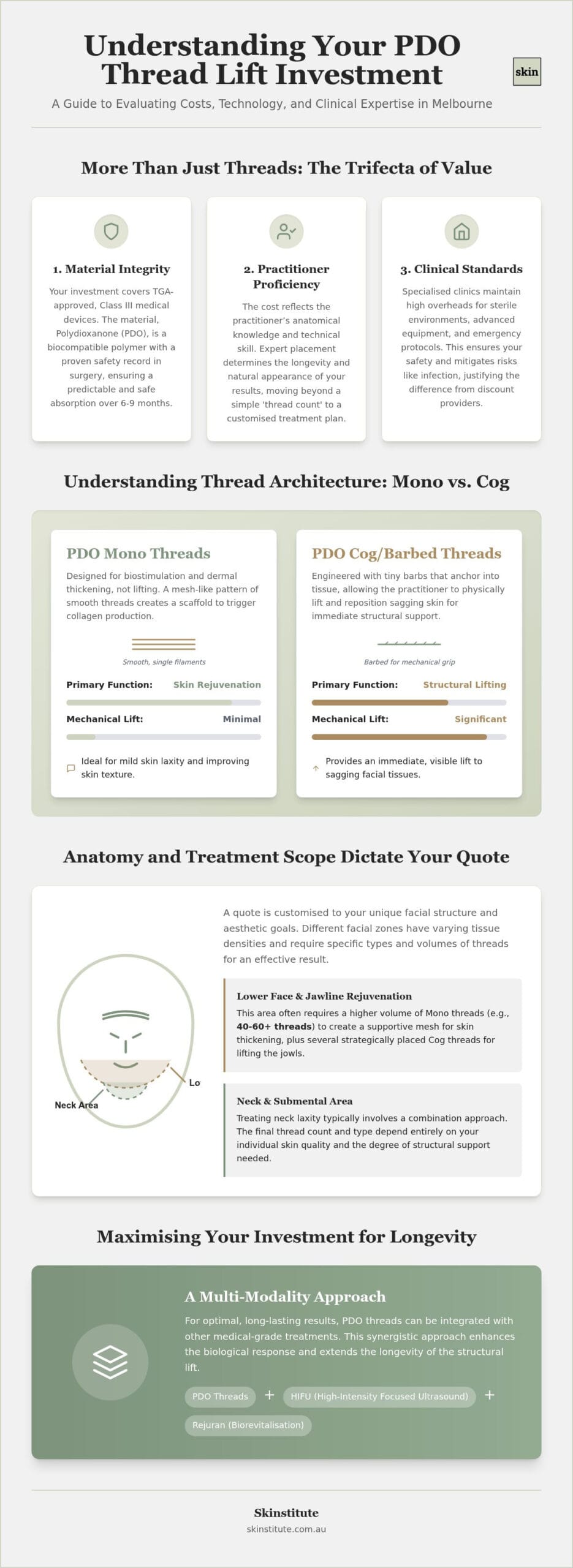
A PDO thread lift is a minimally invasive procedure utilising TGA-approved sutures to stimulate neocollagenesis and provide structural support. When patients investigate the cost of pdo thread lift melbourne, it’s vital to recognise that they aren’t simply purchasing a product. Instead, they’re investing in a medical-grade intervention designed to reinforce the skin’s internal architecture. This investment is defined by a trifecta of material integrity, practitioner proficiency, and the safety standards of the clinical facility.
The total financial commitment reflects the dual nature of the treatment. Some threads are designed for biostimulatory effects, focusing on dermal thickening through collagen induction. Others provide a mechanical lift, using intricate barbs to reposition sagging tissue. While the technical evolution of the thread lift procedure has roots in traditional surgery, modern PDO applications allow for structural changes without the extensive downtime of invasive alternatives.
The Role of Polydioxanone (PDO) in Aesthetic Medicine
Polydioxanone is a robust, synthetic polymer with a distinguished history in cardiovascular surgery, where its safety and biocompatibility were first established. Its primary advantage in aesthetic medicine is its predictable degradation profile. The body absorbs these sutures through a natural process called hydrolysis, typically occurring over a period of six to nine months. In Australia, the Therapeutic Goods Administration (TGA) classifies these threads as Class III medical devices. This classification ensures that the materials meet rigorous safety standards, which is a critical consideration for any patient prioritising clinical safety over discounted rates.
Investment vs. Price: Why Quotes Vary Across Melbourne Clinics
Discrepancies in the cost of pdo thread lift melbourne often stem from the operational philosophy of the provider. Specialised medical aesthetic centres operate with high clinical overheads to maintain sterile environments and strict emergency protocols. These costs include professional indemnity insurance, continuous practitioner training, and advanced sterilisation equipment. Conversely, discount strip-mall clinics may reduce their quotes by utilising fewer threads per area or employing less experienced injectors. A lower initial price often signals a compromise in the technical complexity of the pattern used; this directly impacts the longevity and natural appearance of the final result.
Mono vs. Cog Threads: How Technical Specifications Impact Pricing
The technical specification of the thread selected is a primary determinant of the cost of pdo thread lift melbourne treatments. While all threads are composed of polydioxanone, their physical structure dictates their clinical function and the level of expertise required for insertion. Understanding these differences allows patients to move beyond price-per-thread comparisons and appreciate the engineering behind their results.
PDO Mono Threads: The Biostimulatory Investment
Mono threads are smooth, single-filament sutures designed primarily for dermal thickening. Unlike lifting threads, they don’t possess barbs to grip the tissue. Instead, they’re inserted in a ‘mesh’ or ‘grid’ pattern to create a scaffolding that triggers the body’s natural wound-healing response. This process, known as neocollagenesis, improves skin density and texture over several months. Because these threads are relatively simple to manufacture and insert, the cost per thread is lower. However, achieving a visible clinical result often requires a high-volume count, sometimes exceeding 40 to 60 threads for a single area like the lower face or neck. This volume-based approach is ideal for younger patients or those seeking to address fine lines and mild skin laxity without requiring mechanical repositioning.
PDO Cog and Barbed Threads: Mechanical Lifting and Structural Support
Cog threads represent a more complex engineering solution for facial rejuvenation. These sutures feature tiny barbs or ‘cogs’ that are either cut into the thread or moulded around it. These barbs act as anchors, allowing the practitioner to physically lift and reposition sagging tissue. This mechanical action provides an immediate structural change that mono threads cannot achieve. The manufacturing process for cog threads is significantly more intricate, requiring precision to ensure the barbs don’t weaken the thread’s core.
The technical difficulty for the practitioner also increases substantially with cog threads. Successful application requires an advanced understanding of facial vectors and deep fat pads to ensure symmetry and prevent visible ‘puckering’ or ‘tethering’ of the skin. Given the higher risk profile and the advanced training required to master these vectors, the investment for a cog thread procedure is higher. When evaluating the clinical standards for thread lifting, it’s evident that the practitioner’s ability to navigate these anatomical complexities is what ensures a predictable and safe outcome.
Between these two extremes lie ‘Screw’ or ‘Tornado’ threads, which consist of one or two filaments coiled around the insertion needle. These provide a middle ground by offering more surface area for collagen stimulation than a standard mono thread, making them effective for adding volume to hollow areas like the nasolabial folds. Ultimately, a natural-looking result rarely relies on a single thread type. Most comprehensive treatment plans utilise a strategic combination: cog threads for structural lifting and mono threads to refine skin texture and support the newly lifted architecture. This multi-layered approach ensures the face doesn’t appear ‘over-filled’ or distorted, but rather restored to its natural anatomical position.
Regional Anatomy and Treatment Scopes: What Determines Your Quote?
When evaluating the cost of pdo thread lift melbourne, it’s essential to understand that quotes are not based on arbitrary ‘areas’ but on the anatomical complexity of the region being treated. Facial anatomy is a dynamic system of fat pads, ligaments, and varying skin densities. Consequently, a patient requiring a targeted ‘Mini Lift’ to address a single concern will see a different investment profile than one opting for a ‘Full Face Lift’ that requires a multi-vector approach across several planes. The degree of tissue laxity and the weight of the skin determine the specific architecture of the thread placement.
Addressing the Lower Face and Jawline
The lower face is often the primary concern for patients noticing the development of jowls or marionette lines. Treating this region is technically demanding because the practitioner must counteract the effects of gravity on relatively heavy tissue. Defining a crisp mandibular line typically requires a hybrid strategy. This involves high-tensile cog threads to physically reposition the tissue, supported by a mesh of mono threads to reinforce the skin’s structural integrity. Because this area requires robust anchoring and a higher thread count to achieve a visible, lasting result, it often represents the most significant portion of a treatment quote.
Mid-Face and Cheek Rejuvenation
Restoring the ‘Triangle of Youth’ involves lifting the malar fat pads to create a more defined cheek contour and reduce the depth of nasolabial folds. While dermal fillers are often used to replace lost volume, PDO threads offer a mechanical alternative that reposition existing tissue without adding external weight. In many cases, threads provide a more cost-effective solution for patients who would otherwise require multiple vials of filler to achieve a similar lifting effect. To optimise the final outcome, practitioners may recommend a clinical guide to Rejuran to improve skin quality and bio-stimulation alongside the structural lift.
Neck and Brow Lifting: Precision-Based Pricing
The neck and brow regions require an exceptional level of precision due to the thinness of the skin and the proximity to vital structures. A PDO brow lift, often used to create a subtle ‘Fox Eye’ effect, demands careful placement near the orbital rim to ensure safety and symmetry. Similarly, treating the neck requires a delicate balance to avoid visible puckering or tethering during movement. These areas carry a clinical premium because the margin for error is slim; the practitioner’s expertise in navigating these delicate zones is a key factor in the overall cost of pdo thread lift melbourne. Successful outcomes here depend on meticulous vectoring and a deep understanding of superficial musculoaponeurotic system (SMAS) layers.
Beyond the Threads: Why Clinical Expertise and Facility Standards Matter
While the technical specifications of the sutures are significant, the most substantial component of the cost of pdo thread lift melbourne is the practitioner’s anatomical expertise. Thread lifting is a procedure that requires an intimate understanding of the sub-dermal layers, including the location of facial nerves and major blood vessels. A seasoned practitioner doesn’t just insert a thread; they navigate complex biological structures to ensure the lift is both effective and safe. Operating within a sterile, medical-grade environment is a fundamental requirement to mitigate the risk of biofilm formation or infection. Skinstitute’s 26-year legacy in Melbourne serves as a benchmark for these safety protocols, providing patients with the assurance that their treatment is conducted under the highest clinical standards.
The Risks of Low-Cost ‘Budget’ Thread Lifts
Opting for a budget-oriented clinic often introduces significant clinical risks that far outweigh the initial savings. Low-cost procedures frequently utilise threads with inferior tensile strength or those that haven’t undergone rigorous TGA evaluation. These materials are more prone to snapping or failing to provide adequate anchorage. Common complications arising from inexperienced application include:
- Asymmetry: Incorrect vector planning leads to an uneven facial appearance.
- Thread Extrusion: Poorly placed threads may migrate or poke through the skin surface.
- Infection and Biofilm: Non-sterile techniques can lead to chronic inflammatory responses.
The ‘hidden’ cost of these discount treatments is the subsequent corrective work required to address a botched result. Removing migrated threads or treating chronic inflammation is often more expensive and technically challenging than the original procedure. It’s vital to prioritise clinics that offer comprehensive complication management as part of their professional service.
Consultation and Personalised Clinical Assessment
A ‘one-size-fits-all’ price list is clinically irresponsible because it fails to account for individual biological variability. A professional clinic prioritises a thorough Skinstitute Melbourne clinical guide approach, which begins with a detailed facial mapping session. During this assessment, the practitioner identifies specific vectors of descent and determines the exact count and type of threads required for your unique anatomy. This precision-based planning ensures that the result remains natural and avoids the ‘over-pulled’ look associated with generic patterns. To ensure your treatment plan is tailored to your specific structural needs, we recommend booking a professional clinical assessment with our experienced team.
Maximising Your Investment: Multi-Modality and Maintenance
The clinical success of a structural intervention is often dependent on the biological health of the surrounding tissue. When evaluating the total cost of pdo thread lift melbourne, it’s prudent to consider the concept of ‘Bio-Stimulatory Synergy’. This approach involves combining mechanical lifting with other medical-grade modalities to ensure the skin is physiologically capable of supporting the new architecture. By addressing the skin’s health alongside its structure, practitioners can extend the longevity of the results and achieve a more comprehensive rejuvenation.
High Intensity Focused Ultrasound (HIFU) is frequently utilised as a priming treatment. By targeting the deeper SMAS layer with thermal energy, HIFU induces internal tissue contraction and provides a firmer foundation for subsequent thread placement. This internal tightening ensures that the thread vectors are more effective; it often reduces the total volume of threads required to achieve the desired lift. Maintaining this structural integrity also requires a commitment to medical-grade skincare that supports the continued production of thread-induced collagen.
PDO Threads and Rejuran: The Ultimate Skin Regeneration Duo
Rejuran, composed of polynucleotides, serves as a biological repair agent that improves the quality of the ‘soil’ while threads provide the ‘structure’. While PDO threads create a physical scaffold, Rejuran works at a cellular level to repair damaged DNA and stimulate fibroblasts. This dual-modality approach addresses both tissue laxity and the underlying biological aging of the skin. Patients often find this combination provides a superior cost-benefit profile; the improved skin quality enhances the light-reflective properties of the face, making the structural lift appear more natural and vibrant. Treating skin health and laxity simultaneously ensures that the new contours are supported by resilient, hydrated tissue.
The Role of Fractional CO2 and HIFU in Long-Term Maintenance
Threads are highly effective at repositioning tissue, but they cannot address surface-level concerns like pigmentation, deep rhytids, or irregular texture. Fractional CO2 Laser Resurfacing is an essential tool for refining the skin’s surface, creating a cohesive aesthetic result that threads alone cannot provide. To protect the initial investment, a tiered maintenance plan is typically recommended over a two to three-year period. This may include:
- Annual HIFU Sessions: To maintain deep-layer tension and prevent further descent.
- Strategic ‘Top-Up’ Mono Threads: Inserting small volumes of smooth threads every nine to twelve months to reinforce collagen scaffolding.
- Periodic Bio-Stimulation: Utilising Rejuran or exosomes to maintain cellular health and skin density.
By following a structured maintenance timeline, patients can avoid the need for a full corrective procedure in the future. This methodical approach ensures that the cost of pdo thread lift melbourne is a sustainable investment in long-term facial harmony rather than a temporary fix.
Securing Your Aesthetic Future Through Clinical Precision
Evaluating the cost of pdo thread lift melbourne requires a shift from viewing the procedure as a commodity to recognising it as a sophisticated medical intervention. A successful outcome depends on the practitioner’s ability to navigate complex facial vectors and the utilisation of TGA-approved materials within a sterile facility. By understanding how thread architecture and regional anatomy dictate your treatment plan, you can make an informed decision based on clinical merit rather than raw price points. Integrating these structural supports with complementary modalities like HIFU or Rejuran further ensures that your investment yields resilient, natural-looking results.
With over 26 years of clinical experience, our team prioritises medical-grade standards and technical mastery in every rejuvenation plan. We invite you to Book a Clinical Consultation at Skinstitute Melbourne to receive a personalised assessment tailored to your unique anatomical requirements. This professional evaluation is the most reliable way to understand the specific variables of your treatment and ensure your safety remains the primary focus. We look forward to partnering with you on your journey toward long-term structural skin health.
Frequently Asked Questions
How much does a PDO thread lift typically cost in Melbourne?
The cost of pdo thread lift melbourne is determined by the specific anatomical requirements of the patient and the type of threads utilised. While industry averages exist for mono and cog threads, a definitive quote is only possible following a thorough clinical assessment. This investment reflects the practitioner’s expertise, the use of TGA-approved materials, and the maintenance of sterile facility standards. A personalised plan ensures you only pay for the precise architecture needed for your results.
Why is a thread lift more expensive than dermal fillers?
A thread lift involves a higher technical complexity and a different biological mechanism compared to dermal fillers. While fillers primarily replace lost volume by adding substance, threads provide a mechanical lift and structural scaffolding. The manufacturing process for high-tensile, barbed cog threads is more intricate; the procedure requires advanced vector planning. This structural intervention typically offers a longer duration of effect, often lasting 12 to 18 months, which justifies the higher initial investment.
How many PDO threads are usually needed for a full face lift?
The number of threads required for a full facial rejuvenation varies significantly based on tissue laxity and the desired degree of lifting. A comprehensive plan often involves a hybrid approach, utilising approximately 4 to 10 cog threads for structural lifting and 40 to 80 mono threads for dermal thickening. This multi-layered strategy ensures a natural appearance by reinforcing the skin’s architecture across the mid-face, jawline, and neck rather than relying on a single vector.
Does the cost of a thread lift include follow-up appointments?
Professional clinical standards dictate that a comprehensive treatment quote should encompass the initial procedure and necessary post-operative care. At a medical-grade facility, follow-up appointments are essential to monitor the hydrolysis process and ensure the tissue is responding correctly to the biostimulatory mesh. These reviews allow practitioners to assess the symmetry and structural integrity of the lift as the initial swelling subsides, ensuring the long-term success of the aesthetic investment and patient safety.
Is a PDO thread lift worth the investment compared to surgery?
For patients seeking structural improvement without the risks of invasive plastic surgery, a PDO thread lift offers a compelling value proposition. While a surgical facelift provides more permanent results, it involves significant downtime, general anaesthesia, and higher clinical risks. A thread lift is a minimally invasive alternative that stimulates neocollagenesis and provides a mechanical lift with minimal recovery time. It serves as an effective preventative or corrective measure for moderate laxity before surgery becomes necessary.
Are there any hidden costs involved in the recovery or aftercare?
Transparent clinical quotes should minimise hidden expenses, though patients should consider minor ancillary costs for optimal recovery. These may include specialised post-treatment skincare or compression garments for certain areas. Most reputable Melbourne clinics include the primary aftercare protocols in their initial fee. It’s important to clarify if the quote covers complication management; this reflects the clinic’s commitment to patient safety and the professional integrity of their medical services over a 26-year legacy.
Can I combine a thread lift with other treatments to save on costs?
Combining modalities often provides a more cost-effective outcome by enhancing the biological response and extending the longevity of the results. For instance, priming the skin with HIFU or Rejuran can improve tissue density, potentially reducing the number of threads required for a successful lift. This multi-modality approach addresses both surface texture and deep structure simultaneously. While the initial outlay may be higher, the long-term cost of pdo thread lift melbourne is reduced through superior aesthetic longevity.
What should I look for in a clinic’s quote to ensure it is legitimate?
A legitimate quote must clearly identify the type and count of threads, the practitioner’s qualifications, and the facility’s safety standards. Ensure the materials are TGA-approved and that the clinic maintains a sterile, medical-grade environment. Be cautious of quotes that seem unusually low; they may indicate the use of inferior materials or a lack of professional indemnity. A detailed consultation that includes facial mapping and a clear explanation of the technical plan is a hallmark of a professional clinic.