Skin Needling Melbourne: A Clinical Guide to Dermal Remodelling
June 8, 2026
Prescription Injectables for Facial Contouring in Melbourne
June 10, 2026
Australians now spend over A$1 billion annually on cosmetic procedures, a statistic that underscores a growing collective commitment to advanced dermatological health. For those considering fractional co2 melbourne practitioners offer a sophisticated solution for addressing persistent acne scarring and the accelerated photo-ageing common in our high-UV environment. It’s understandable to feel frustrated when high-end topical treatments fail to produce visible changes in skin depth or texture. You recognise that meaningful rejuvenation often requires a more intensive, medically supervised approach to reach the deeper layers of the dermis.
This guide provides a clinical overview of how fractional laser technology facilitates a biological reset by inducing a precise, controlled thermal injury. You’ll learn about the physiological stages of dermal regeneration, the importance of using TGA-registered medical devices, and what to expect during the structured recovery phase. Our objective is to move beyond surface-level descriptions, offering the technical insight necessary for you to understand how this procedure regenerates the skin’s structural matrix. We’ll outline the healing trajectory and the safety protocols that ensure your treatment plan is both effective and predictable.
Key Takeaways
- Understand the technical distinction of the fractional method, which targets microscopic columns of skin to facilitate a more efficient healing process through preserved surrounding tissue.
- Gain insight into the biological mechanism of photo-fractional thermolysis, where controlled thermal damage triggers a comprehensive wound-healing cascade for dermal matrix regeneration.
- Evaluate why fractional co2 melbourne protocols are often preferred over non-ablative alternatives for addressing deep-seated acne scarring and advanced photo-ageing.
- Learn the clinical importance of pre-conditioning the skin with tyrosinase inhibitors to minimise the risk of post-inflammatory hyperpigmentation and ensure a stable recovery.
- Discover how a bespoke, medically supervised treatment plan leverages established scientific principles to deliver predictable and significant skin texture improvements.
Understanding Fractional CO2 Laser Technology in the Melbourne Context
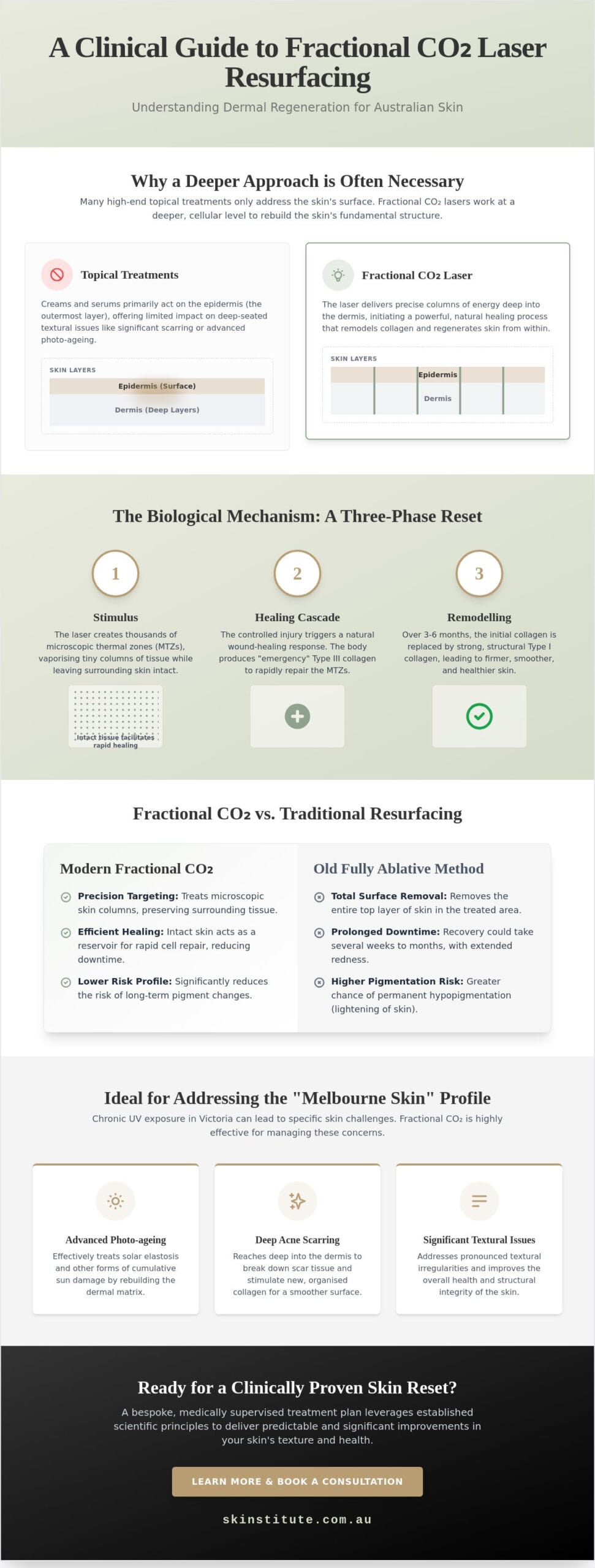
The fractional carbon dioxide (CO2) laser is a premier ablative resurfacing modality designed to address significant textural irregularities and dermal compromise. By utilising Carbon-dioxide laser technology, practitioners can deliver a specific wavelength of 10,600 nm to vaporise water-rich tissues with microscopic precision. For those researching fractional co2 melbourne clinics provide a refined method where the beam is pixelated into thousands of microscopic treatment zones. This technology treats specific columns of skin while leaving the surrounding tissue intact, which facilitates a more rapid healing response and reduces the overall risk profile of the procedure. A medical-grade assessment is a non-negotiable prerequisite to determine if this high-energy intervention is suitable for your specific dermal thickness, as it allows the practitioner to evaluate the degree of solar damage and existing skin health.
The Evolution from Traditional to Fractional Resurfacing
Historically, “fully ablative” lasers removed the entire surface of the skin, leading to prolonged erythema and a significant risk of permanent hypopigmentation. Modern fractional precision allows for a more controlled thermal injury by creating a pattern of treated and untreated zones. This method significantly reduces the risk of long-term pigmentary changes, making it a safer option for those seeking fractional co2 melbourne results. By adjusting pulse durations and energy levels, we can customise the treatment to suit different skin thicknesses and specific anatomical regions. This evolution means that we can target deeper dermal concerns without the multi-month recovery periods associated with the technologies of the past.
Addressing the “Melbourne Skin” Profile
Victorian patients often present with specific challenges related to chronic UV exposure, such as solar elastosis and actinic damage. This “Melbourne skin” profile requires a nuanced approach to thermal injury, as the dermal response can be altered by years of cumulative sun damage. Laser resurfacing plays a critical role in managing these textural changes and improving the overall health of the skin matrix. We often recommend scheduling these intensive procedures during the lower UV months in Melbourne. This seasonal timing is a clinical recommendation to protect the vulnerable, regenerating epithelium from the intense Australian sun, ensuring the long-term stability of the results and reducing the likelihood of post-procedure complications.
The Biological Mechanism: Photo-Fractional Thermolysis and Tissue Regeneration
The clinical efficacy of resurfacing relies on the principle of photo-fractional thermolysis. This process involves the delivery of laser energy in a pixelated pattern, creating thousands of Microscopic Treatment Zones (MTZs) that extend from the epidermis into the papillary and reticular dermis. By leaving the surrounding tissue intact, these zones act as a biological reservoir for rapid cellular repair. This targeted approach is central to the efficacy of fractional co2 melbourne treatments, as it allows for profound structural change without the extensive downtime associated with traditional ablative methods.
Immediately following the thermal stimulus, the skin initiates a complex wound-healing cascade. The first cellular responders are Heat Shock Proteins (HSPs), specifically HSP70 and HSP47. These proteins act as molecular chaperones, assisting in protein folding and protecting cells from further thermal stress. This rapid response is a critical component of the clinical overview of CO2 laser resurfacing, as it sets the stage for long-term neocollagenesis. This regenerative phase isn’t instantaneous; it’s a physiological evolution that continues for up to six months as the dermal matrix is systematically rebuilt.
Dermal Remodelling and Collagen Synthesis
During the remodelling phase, the body replaces the initial Type III “emergency” collagen with robust Type I structural collagen. The laser energy vaporises the water within the targeted columns, causing immediate contraction of the collagen fibres and a perceptible tightening of the dermal matrix. This process follows a predictable biological sequence:
- Immediate Contraction: Thermal energy causes the triple-helix structure of collagen to shrink, providing an instant lifting effect.
- Inflammatory Phase: Cytokines and growth factors are released to stimulate fibroblast activity within the MTZs.
- Proliferative Phase: New collagen and elastin fibres are produced over several weeks, improving skin density.
Practitioners must calibrate the laser depth precisely to address different concerns. Treating deep-seated acne scars requires deeper penetration into the reticular dermis, whereas superficial fine lines may only require epidermal targeting. This level of precision ensures that the treatment is tailored to the patient’s specific anatomical needs.
Re-epithelialisation and the Healing Timeline
Re-epithelialisation begins within hours of the procedure as keratinocytes from the adjacent healthy tissue migrate to close the laser-induced micro-channels. Fibroblasts within the dermis are activated to synthesise a new, more organised extracellular matrix, providing the structural support for the regenerated skin. Patients often observe a “bronzing” effect between days three and five. This is a normal physiological response where the skin sheds microscopic epidermal necrotic debris (MENDs) as the new, healthier tissue reaches the surface. Understanding these biological milestones helps patients feel more confident during their recovery journey. If you are interested in how these mechanisms apply to specific skin concerns, you may find it useful to review our acne scar treatment Melbourne clinical checklist.
Fractional CO2 vs. Alternative Resurfacing Modalities
Selecting the appropriate resurfacing modality requires a nuanced understanding of how different energy sources interact with the skin’s biological structures. While Erbium:YAG lasers are often utilised for superficial texture refinement due to their high water absorption and minimal thermal spread, the fractional CO2 laser remains the clinical standard for more profound dermal restructuring. The 10,600 nm wavelength of the CO2 laser provides a unique balance of ablation and coagulation. This dual action is particularly effective for patients seeking fractional co2 melbourne services to address deep rhytids or complex, fibrotic scarring where mechanical injury alone may prove insufficient.
In clinical practice, we often differentiate between mechanical injury and thermal energy. Skin needling creates physical micro-channels to stimulate a healing response without the use of heat. While effective for mild texture issues, it lacks the ability to induce the significant collagen contraction provided by the CO2 laser’s thermal energy. For patients following specific acne scar treatment Melbourne protocols, the thermal “reset” of a CO2 laser is often necessary to remodel the dense, tethered collagen found in ice-pick or boxcar scars. This “sweet spot” for CO2 involves treating structural laxity and deep epidermal irregularities that lighter aesthetic peels cannot reach.
CO2 Laser vs. HIFU for Skin Laxity
It’s essential to distinguish between surface texture refinement and deep structural lifting. High Intensity Focused Ultrasound (HIFU) targets the Superficial Muscular Aponeurotic System (SMAS) layer, providing a non-invasive lift by tightening the foundational tissues. Conversely, the fractional CO2 laser focuses on the epidermis and dermis to improve surface irregularities and dermal density. When a patient presents with both significant laxity and advanced photo-ageing, a sequential treatment plan is often recommended. This approach ensures that the structural foundation is addressed before refining the skin’s visible surface through fractional co2 melbourne protocols.
Bio-Stimulators as a Complementary Force
Modern clinical strategies frequently integrate bio-stimulators to enhance the outcomes of ablative procedures. Our Rejuran Melbourne protocols involve the use of polynucleotides to support the healing environment. While the CO2 laser provides a thermal reset by removing damaged tissue, Rejuran functions as a repair mechanism by promoting cellular regeneration and hydration. Polynucleotides are often used to prime the skin before a laser session, ensuring the dermal matrix is sufficiently resilient to respond optimally to the controlled thermal injury. This synergy between thermal ablation and biological repair allows for more predictable results and a more efficient recovery phase.
Clinical Protocols: Preparation, Procedure, and Melbourne Recovery
Successful outcomes in fractional co2 melbourne clinics are determined long before the laser is activated. A rigorous pre-conditioning phase is essential to stabilise the skin’s melanocytes, particularly for patients with a history of significant Australian UV exposure. We mandate the use of tyrosinase inhibitors for at least two to four weeks prior to the procedure. This clinical intervention reduces the risk of post-inflammatory hyperpigmentation (PIH) by suppressing overactive pigment-producing cells. Additionally, in accordance with the 2023 AHPRA reforms, all patients must undergo a mandatory mental health screening to ensure they possess realistic expectations and are suitable candidates for a procedure involving a structured recovery period.
The procedure itself is managed with technical precision to ensure patient comfort. We apply a high-strength topical anaesthesia for approximately 45 to 60 minutes before the treatment commences. During the session, clinical cooling systems are utilised to mitigate the “prickling” or “snapping” sensation as the laser vaporises microscopic columns of tissue. The recovery arc typically spans seven days. Initial erythema and oedema are expected in the first 48 hours, followed by a “bronzing” phase where the skin feels sandpaper-like as it sheds necrotic debris. By day seven, the fresh epithelium is revealed, though the underlying neocollagenesis will continue for several months.
The Essential Pre-Treatment Checklist
Adherence to a strict preparatory checklist is vital for minimising complications. Patients must commit to absolute sun avoidance and the application of medical-grade SPF 50+ for four weeks leading up to the appointment. It’s necessary to cease the use of active ingredients, such as Retinoids and AHAs, seven days prior to ensure the skin barrier is stable. For those with a history of herpes simplex, we prescribe prophylactic anti-viral medication to prevent a viral flare-up during the inflammatory healing phase. If you’re ready to begin this structured process, you can book a clinical consultation to discuss your bespoke preparation plan.
Post-Laser Aftercare and Protection
The “soak and seal” method is the cornerstone of effective aftercare, involving gentle saline compresses followed by the application of an occlusive balm. This maintains a moist environment, which is proven to accelerate re-epithelialisation compared to dry healing. We advise against using Melbourne’s hard water or harsh cleansers for the first 48 hours to avoid irritating the micro-channels. Managing the “Melbourne Factor” is also critical; the high UV spikes and intense glare, even on overcast days, can compromise healing skin. Physical sunscreens containing Zinc Oxide or Titanium Dioxide are preferred over chemical filters during early recovery, as they provide a non-irritating, reflective barrier against radiant heat and UV radiation.
Why Clinical Expertise Matters for Fractional CO2 at Skinstitute
Leveraging over 26 years of industry experience in medical-grade aesthetic procedures, Skinstitute prioritises technical precision over commercial trends. When patients research fractional co2 melbourne practitioners, they often encounter broad marketing claims that overlook the complexity of laser physics. Our approach is rooted in the understanding that every skin phenotype requires a unique calibration of laser parameters. A seasoned practitioner doesn’t rely on factory presets; instead, they meticulously adjust the energy, density, and “stack” of the laser pulses to match the specific anatomical needs of the patient’s dermal matrix. This level of clinical rigour ensures that the controlled thermal injury is deep enough to initiate remodelling without exceeding the skin’s capacity for safe repair.
We address the common SERP gap regarding post-laser recovery by integrating cutting-edge regenerative therapies into our fractional CO2 laser resurfacing Melbourne protocols. Specifically, the application of Exosomes immediately following treatment acts as a biological catalyst. These nano-vesicles contain a concentrated profile of growth factors and signalling proteins that communicate directly with fibroblasts to accelerate re-epithelialisation. By utilizing the micro-channels created by the laser, we deliver these regenerative molecules into the deeper dermal layers, effectively shortening the inflammatory window and enhancing the final structural outcome.
The Skinstitute Difference: Medical Rigour Meets Aesthetic Artistry
Our clinical team specialises in prescription-only medical aesthetics, providing a safety profile that exceeds standard cosmetic environments. We calibrate three primary variables for every session:
- Energy (mJ): Determining the depth of the microscopic treatment zones to reach specific scar tissue or rhytids.
- Density: Adjusting the percentage of the skin surface treated to balance efficacy with the patient’s downtime capacity.
- Stack: Utilizing multiple pulses in a single spot to increase thermal coagulation in areas of significant laxity.
This technical transparency ensures you understand the “why” behind every adjustment, fostering a partnership based on evidence-based results rather than ambiguous promises.
Future-Proofing Your Results
The conclusion of your laser session is the beginning of a long-term skin health monitoring phase. To preserve the collagen gains achieved through CO2, we develop a bespoke maintenance plan that may involve Skin Needling or bio-stimulators to maintain dermal density. The role of medical-grade skincare is also vital; using specific antioxidants and DNA repair enzymes helps protect the newly regenerated epithelium from further solar elastosis. We invite you to book a clinical assessment at our Melbourne centre to begin a structured, medically supervised journey toward dermal regeneration.
Begin Your Dermal Regeneration Journey with Confidence
Fractional CO2 laser resurfacing represents a clinically validated pathway to meaningful structural skin improvement, particularly for those navigating the compounding effects of Australia’s high-UV environment. The key principles established throughout this guide are worth holding onto: the fractional method’s biological efficiency relies on preserving surrounding tissue as a cellular reservoir, the wound-healing cascade continues remodelling the dermal matrix for months after treatment, and rigorous pre-conditioning is what separates predictable outcomes from avoidable complications.
Choosing the right clinical environment is as important as choosing the right procedure. For fractional co2 melbourne patients, Skinstitute offers over 26 years of medical aesthetic experience, specialist expertise in regenerative therapies including Exosomes and Rejuran, and a fully medically supervised treatment environment. Every parameter is calibrated to your specific skin phenotype, not a generalised preset.
Your skin’s capacity for regeneration is remarkable. With the right clinical partnership, that potential becomes a predictable, structured outcome. Book your clinical fractional CO2 consultation at Skinstitute Melbourne and take the first informed step toward a genuinely renewed dermal matrix.
Frequently Asked Questions
How long does the redness last after a fractional CO2 laser treatment in Melbourne?
Redness typically persists for five to seven days following a fractional co2 melbourne treatment. During the first 48 hours, the skin exhibits a deep erythema similar to a significant sunburn, which gradually transitions to a “bronzed” or tanned appearance. By the end of the first week, the superficial layers shed to reveal new epithelium, though a subtle pinkness may remain for several weeks as the underlying dermal matrix continues its inflammatory healing phase.
Is fractional CO2 laser resurfacing painful during the procedure?
Most patients describe the procedure as a tolerable “prickling” or “snapping” sensation rather than acute pain. We mitigate discomfort by applying a high-strength topical anaesthesia for 60 minutes prior to the session and utilising integrated clinical cooling systems during the laser delivery. While the sensation is noticeable, the systematic application of thermal energy is designed to be manageable within a medically supervised environment, with post-procedure heat typically subsiding within a few hours.
How many sessions of fractional CO2 are typically required for acne scars?
Most patients require between one and three sessions to achieve significant reduction in acne scar depth. The exact number of treatments depends on the fibrotic nature of the scarring and the patient’s capacity for downtime. While a single intensive session can yield substantial results, a staged approach often allows for deeper dermal penetration with a more controlled recovery profile, ensuring the skin has adequate time to synthesise new structural collagen between appointments.
Can I have fractional CO2 laser if I have a darker skin tone?
Patients with darker skin tones can undergo fractional CO2 resurfacing, but it requires a more cautious clinical protocol. To prevent post-inflammatory hyperpigmentation, a mandatory four-week pre-conditioning phase using tyrosinase inhibitors is essential. We also adjust the laser’s density and energy settings to ensure the thermal injury remains within safe biological limits, prioritising the integrity of the melanocytes while still achieving the desired textural improvements.
What is the difference between fractional CO2 and Fraxel laser?
The primary difference lies in the laser’s wavelength and its interaction with the skin’s water content. Fractional CO2 utilises a 10,600 nm wavelength, which is a fully ablative technology that vaporises columns of tissue for more intensive remodelling. In contrast, many Fraxel devices are non-ablative, meaning they heat the tissue without removing the surface layer. This makes fractional co2 melbourne protocols more effective for deep-seated structural concerns like advanced photo-ageing and tethered acne scars.
When is the best time of year in Melbourne to undergo laser resurfacing?
Autumn and winter are the optimal seasons in Melbourne for undergoing laser resurfacing due to the lower ambient UV levels. Since the newly regenerated epithelium is highly susceptible to solar damage, performing the procedure during months with shorter daylight hours reduces the risk of accidental UV exposure during the critical early healing phase. Even during these cooler months, strict adherence to physical sunscreens is necessary to protect the skin from Victoria’s unpredictable glare.
What are the potential risks or side effects of fractional CO2 laser?
Potential risks include prolonged erythema, temporary pigmentary changes, and a risk of infection if aftercare protocols are not followed. Post-inflammatory hyperpigmentation is the most common concern, which is why we emphasise pre-treatment skin priming. While rare in a clinical setting, more serious complications like scarring or viral flare-ups are managed through precise laser calibration and prophylactic medications, ensuring the procedure remains within a high safety threshold for all patients.
How soon will I see the final results of my CO2 laser treatment?
You will observe the final structural results approximately three to six months after your procedure. While an immediate tightening effect occurs due to collagen fibre contraction, the biological process of neocollagenesis is a slow physiological evolution. It takes several months for the body to systematically replace “emergency” collagen with organised Type I structural collagen. The improvements in skin density and scar depth continue to refine as the dermal matrix matures over this extended period.