Laser Resurfacing vs Microneedling: A Melbourne Clinical Comparison Guide
September 24, 2026
Cosmetic Treatment Payment Plans in Melbourne: What to Check Before You Book
September 26, 2026
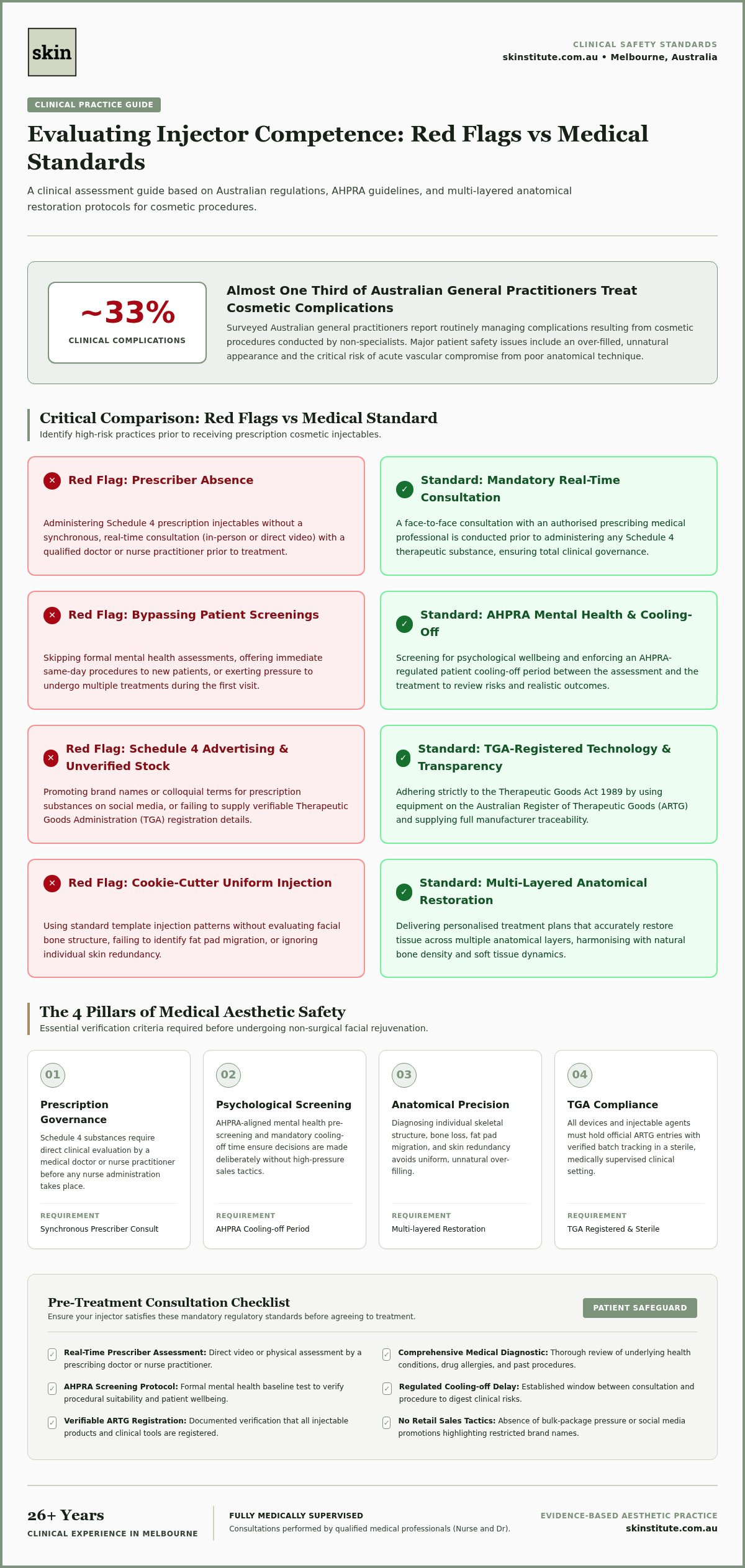
Almost one third of Australian general practitioners report treating patients for complications arising from cosmetic procedures performed by non-specialists. This data reflects a significant risk in an industry where the distinction between a medical procedure and a beauty service is frequently obscured. You may feel a legitimate sense of apprehension regarding the potential for an unnatural, over-filled appearance or the risk of vascular compromise. Navigating the varying qualifications of practitioners in Melbourne creates understandable confusion, especially when your safety depends on anatomical precision.
This clinical guide identifies the critical red flags and signs of a bad cosmetic injector to ensure your aesthetic journey prioritises physiological safety. We will outline the mandatory AHPRA regulatory requirements, including the necessity for real-time consultations with prescribing practitioners for Schedule 4 medicines. By understanding these technical standards and the importance of a medically supervised environment, you can gain the confidence to choose a practitioner who values evidence-based results over marketing trends. This checklist serves as a professional framework for vetting clinics, focusing on TGA-registered technology and the multi-layered anatomical restoration required for a stable, high-quality outcome.
Key Takeaways
- Identify why a face-to-face consultation with a prescribing medical professional is a mandatory clinical requirement for all prescription injectables.
- Recognise the critical signs of a bad cosmetic injector by evaluating their adherence to AHPRA guidelines and the transparency of their medical protocols.
- Learn how multi-layered anatomical restoration ensures natural results and prevents the aesthetic complications associated with over-filled facial features.
- Evaluate the hygiene standards of a treatment environment to ensure it meets the medical-grade sterility required for safe, non-surgical facial rejuvenation.
- Establish a professional framework for selecting an established Melbourne clinic with a demonstrated legacy of clinical expertise and industry education.
Red Flags During the Initial Clinical Consultation
A professional aesthetic treatment requires a thorough clinical assessment before any product is administered. One of the most critical signs of a bad cosmetic injector is the complete absence of a detailed medical history and skin analysis during your initial appointment. A practitioner must evaluate your previous health conditions, current medications, and allergies to prevent adverse physiological interactions. Skipping this diagnostic phase introduces severe clinical risks, as certain underlying health profiles or prior treatments can negatively impact tissue response to injectable filler materials.
Australian regulations stipulate that a real-time, face-to-face consultation with an authorised prescribing medical professional, such as a doctor or nurse practitioner, must occur before any Schedule 4 prescription injectables are administered. If a clinic permits a registered nurse to inject a substance without a synchronous video or in-person evaluation by the prescriber, they are operating outside the law. High-pressure sales tactics that encourage you to undergo multiple procedures during your first visit represent another significant warning sign. Safe medical practice dictates that a clinician should provide a transparent overview of realistic expectations and potential clinical risks, allowing you to make an informed decision without commercial coercion.
The Importance of Anatomical Assessment
Every individual presenting for non-surgical facial rejuvenation exhibits a unique skeletal framework and distinct soft tissue distribution. An experienced practitioner evaluates your specific facial structure and bone density to determine how volume loss has altered your appearance over time. When an injector adopts a uniform treatment approach, they ignore critical physiological changes like fat pad migration or skin redundancy. This omission leads to structural imbalances, as the injected product fails to integrate harmoniously with your natural anatomy. A customised regeneration plan is essential to address these multi-layered changes precisely, avoiding standard, cookie-cutter methodologies that compromise your long-term results.
Mental Health Screening and AHPRA Guidelines
Patient safety extends beyond physical anatomy to encompass psychological wellbeing. Skipping the mandatory patient mental health screening is a clear red flag that indicates non-compliance with current AHPRA guidelines. Ethical clinics prioritise this pre-treatment screening to identify underlying psychological risk factors, ensuring that aesthetic procedures are appropriate and safe for the individual. Furthermore, AHPRA-regulated patient cooling-off processes require a structured delay between the initial consultation and the actual procedure for new patients. This mandatory period ensures you have sufficient time to consider the clinical risks, recovery expectations, and procedural outcomes without feeling rushed by the clinic.
Regulatory Non-Compliance and Prescription Injectables
In Australia, the regulatory framework governing aesthetic medicine is designed to protect patient safety through strict control of therapeutic goods. A significant indicator of clinical risk is the unauthorised advertising of Schedule 4 medicines. Under the Therapeutic Goods Act 1989, practitioners are prohibited from using brand names, nicknames, or specific ingredient lists to promote prescription-only substances to the public. One of the most visible signs of a bad cosmetic injector is the use of social media to market these treatments as if they were standard retail products rather than medical interventions.
Transparency regarding the technology and agents used is equally vital. Every medical device, including lasers and high-intensity focused ultrasound systems, must be entered on the Australian Register of Therapeutic Goods (ARTG). Another of the signs of a bad cosmetic injector is the inability to provide TGA-registration details for their equipment or a refusal to disclose the specific manufacturer of the agents being administered. If a practitioner cannot verify the origin of their supplies, they’re likely bypassing essential safety protocols that ensure product purity and clinical efficacy.
Understanding Prescription Requirements in Australia
Prescription injectables are classified as Schedule 4 medicines because they require a high level of medical oversight to manage potential side effects. These substances must only be administered following a valid prescription from an authorised doctor or nurse practitioner. A major red flag is the offering of these treatments in non-clinical environments such as hair salons or private residences. These settings lack the necessary medical-grade sterility and emergency equipment required to manage complications. Legally, a prescription is specific to an individual patient and cannot be shared or administered without a prior clinical assessment by a prescriber.
Verifying Practitioner Registration
Patients should always verify the clinical credentials of their provider via the AHPRA register. This public database allows you to confirm that your practitioner is a registered health professional and check for any conditions placed on their registration. It’s important to distinguish between a qualified cosmetic nurse, who operates under the Medical Board of Australia guidelines, and an untrained individual using misleading titles.
Experience is a critical factor in mitigating risk. At Skinstitute, our 26-year legacy in the Melbourne aesthetic sector provides a level of stability and technical proficiency that newer, less regulated clinics cannot match. When seeking cosmetic injectables in Melbourne, choosing a partner with over 26 years of clinical experience ensures your treatment plan is grounded in established scientific principles and regulatory compliance.
Anatomical Signs of Poor Injection Technique
Poor injection technique often manifests as a distortion of natural facial harmony. When an injector prioritises volume over structure, the result is frequently an over-filled appearance that ignores the golden ratios of human anatomy. Visible lumping or the lateral migration of agents indicates that the product was placed in the incorrect tissue plane. This is one of the clear signs of a bad cosmetic injector. A failure to address multi-layered anatomical restoration leads to a face that looks “done” rather than rejuvenated, as the practitioner has ignored the complex interplay between the upper, middle, and lower facial segments. When the mid-face is over-volumised without considering the temple or jawline, the face loses its natural proportions, resulting in a heavy or “pillowy” look.
The Risk of the Over-Filled Appearance
Over-filling isn’t just an aesthetic concern; it has long-term biological consequences. Injecting excessive volume into the superficial layers can lead to chronic skin redundancy as the tissues are stretched beyond their natural elastic limit. A significant warning sign is the tendency to “chase wrinkles” by filling fine lines without addressing the underlying fat pad migration. This approach adds unnecessary weight to the face, which can actually accelerate sagging over time. A conservative, evidence-based strategy prioritises structural support. By replacing volume only where it has been physiologically lost, a practitioner maintains the integrity of the facial tissues. This methodical approach ensures that the results remain stable and look natural across different facial expressions.
Inadequate Knowledge of Facial Anatomy
Precise administration requires a deep understanding of vascular pathways and nerve distribution. Injectors lacking this technical mastery risk causing vascular occlusion, a severe complication where blood flow is blocked. The FDA patient safety guide on dermal fillers highlights that improper injection technique is a primary driver of adverse events. You might notice signs like epidermal dragging, which suggests poor needle handling or blunt trauma to the tissue. For treatments focusing on collagen induction, achieving the correct dermal depth is paramount. If the practitioner cannot explain the specific biological layer they’re targeting, it signals a lack of the anatomical precision required for a safe medical-grade result. Technical mastery involves understanding how different viscosities interact with specific tissue densities to prevent complications like the Tyndall effect, which causes a visible blue discolouration under the skin.
Clinical Environment and Hygiene Standard Failures
The physical environment where a procedure occurs provides immediate insight into a practitioner’s commitment to patient safety. A treatment room that appears cluttered or poorly organised suggests a lapse in the rigorous protocols required for medical-grade sterility. One of the most critical signs of a bad cosmetic injector is the visible reuse of single-use equipment or the absence of appropriate sharps disposal containers. Practitioners must adhere to strict infection control standards, which includes wearing appropriate personal protective equipment (PPE) such as clinical gloves and face masks during every stage of the administration. If a clinic lacks visible safety equipment or fails to demonstrate clear sanitisation routines between patients, the risk of cross-contamination and procedural infection increases significantly.
Aesthetic Clinic vs. Medical Environment
Aesthetic treatments are medical interventions that involve breaching the skin barrier. Consequently, the setting should reflect a clinical environment rather than a relaxation spa. In advanced therapies, the use of technology that facilitates instant cauterisation is a marker of a professional clinic, as it actively reduces the risk of post-procedural infection. Patients should also verify the use of TGA-registered medical-grade cooling and comfort technology. These systems are designed to manage thermal energy precisely, protecting the surrounding tissue from unnecessary biological damage while ensuring patient comfort throughout the process.
Emergency Readiness and Aftercare
Complication management is a non-negotiable component of aesthetic safety. A major red flag is the absence of a structured aftercare plan or a dedicated contact point for post-treatment concerns. Professional clinics ensure that a Doctor is either on-site or immediately available to manage potential adverse events, such as vascular compromise or unexpected inflammatory reactions. Detailed recovery requirements should always be provided in writing, specifying how the patient should monitor the treated area and which symptoms necessitate urgent clinical review. This transparency ensures that you aren’t left to manage the biological recovery process in isolation, which is often one of the signs of a bad cosmetic injector who prioritises sales over long-term patient outcomes.
To ensure your procedure is performed within a fully medically supervised treatment environment, book a clinical consultation with Skinstitute.
Choosing an Established Melbourne Aesthetic Partner
Selecting an aesthetic partner in Melbourne requires a rigorous evaluation of clinical longevity and professional standing. In an industry where new clinics appear frequently, a long-standing presence serves as a primary marker of stability and technical proficiency. Practitioners who contribute to professional education for other clinicians demonstrate a level of expertise that goes beyond basic administration. This leadership ensures that the clinic remains at the forefront of safety standards and anatomical research, which is the direct antithesis to the common signs of a bad cosmetic injector. A face-to-face consultation remains the non-negotiable first step in any safe treatment journey, as it allows for a personalised assessment that prioritises evidence-based results and long-term skin health over immediate commercial conversions.
The Skinstitute Difference: 26 Years of Mastery
Clinical mastery is not achieved through short-term training; it’s the result of decades of observation and practice. Skinstitute has maintained a presence in the Melbourne aesthetic sector for over 26 years, providing an authoritative medical approach to facial restoration. This 26-year legacy allows for a safer clinical approach, as our practitioners have witnessed the long-term biological interactions of various modalities across thousands of patient profiles. Within a fully medically supervised environment, the administration of prescription injectables is treated as a precise medical event rather than a superficial enhancement. Instead of offering quick fixes that often lead to the complications discussed earlier, we focus on a structured regeneration plan. This strategy prioritises the biological integrity of the skin and multi-layered anatomical restoration, ensuring that results remain harmonious with the natural ageing process.
Next Steps for a Safe Treatment Journey
The transition from concern to clinical solution should be methodical and informed. Preparing for your initial clinical skin analysis involves documenting your full medical history and identifying specific physiological changes, such as volume loss or texture irregularities. During the consultation, you should feel empowered to ask your injector about their AHPRA registration, their specific experience with the proposed procedure, and the TGA-registration status of their technology. A professional clinician will welcome these enquiries as they reflect a mutual commitment to safety and transparency. By focusing on clinics that provide a clear framework for vetting practitioners, you can ensure your aesthetic journey is grounded in medical-grade standards. Avoid the signs of a bad cosmetic injector by choosing a partner who values your psychological wellbeing and anatomical safety above all else.
Organise a professional consultation at our Melbourne clinic.
Securing Your Long-Term Aesthetic Health
Aesthetic safety depends on a practitioner’s ability to integrate anatomical mastery with strict regulatory compliance. Identifying the signs of a bad cosmetic injector involves looking beyond marketing claims to verify clinical protocols. It’s essential to confirm mandatory face-to-face consultations and the use of TGA-registered technology before proceeding. By prioritising clinics that adhere to AHPRA guidelines, you ensure that your treatment plan is both ethically sound and physiologically appropriate.
Skinstitute offers over 26 years of specialised industry experience in Melbourne within a stable, medical-grade environment. Our procedures are performed under the strict supervision of qualified Doctors and Nurses, ensuring every intervention supports multi-layered anatomical restoration. We don’t believe in superficial quick fixes; instead, we focus on technical mastery that respects your natural facial proportions.
Your safety remains our primary clinical priority. Book a clinical consultation with our experienced Melbourne team to begin a structured regeneration plan tailored to your unique anatomy. We look forward to providing the professional guidance you need for a safe and successful aesthetic outcome.
Frequently Asked Questions
How do I check if my cosmetic injector is properly qualified in Australia?
You can verify a practitioner’s credentials by searching the public register maintained by AHPRA. This database confirms their registration status and any conditions placed on their practice. At Skinstitute, we maintain a 26-year legacy in the Melbourne aesthetic sector, ensuring all treatments are delivered by qualified medical professionals. Checking these credentials helps you avoid the signs of a bad cosmetic injector and ensures your provider adheres to Australian health standards.
Is it a red flag if the clinic doesn’t show me the product vial?
Clinical transparency requires that you’re informed about the specific substances being administered. If a practitioner refuses to disclose the manufacturer or show you the TGA-registered vial, it’s a significant red flag. Professional clinics provide this information to confirm product purity and ensure the treatment aligns with your personalised regeneration plan. This practice guarantees that only medical-grade, authentic agents are integrated into your tissues, reducing the risk of adverse biological reactions.
Can a beauty therapist legally administer prescription injectables?
A beauty therapist cannot legally administer prescription injectables in Australia. These substances are Schedule 4 medicines that require a prescription from a doctor or nurse practitioner. Administration must be performed by a registered nurse, doctor, or dentist who possesses the necessary clinical training and anatomical knowledge. Relying on unqualified individuals for medical procedures increases the risk of vascular compromise and other severe complications that a non-medical setting cannot manage.
What should I do if I suspect my injector used a non-TGA approved substance?
If you suspect a non-TGA approved substance was used, you should immediately contact AHPRA or the Therapeutic Goods Administration. Using products not listed on the Australian Register of Therapeutic Goods (ARTG) is illegal and poses extreme health risks. Professional Melbourne clinics exclusively use TGA-registered technology and agents. Reporting these incidents protects the broader community from practitioners who bypass safety regulations to prioritise profit over patient physiological wellbeing and anatomical safety.
Why is a face-to-face consultation with a Doctor necessary for injectables?
A real-time consultation with a prescribing medical professional is a mandatory legal requirement for all Schedule 4 cosmetic treatments. This process ensures a doctor or nurse practitioner has personally evaluated your medical history and anatomical suitability before the prescription is issued. It’s one of the most critical signs of a bad cosmetic injector if they attempt to bypass this step. This clinical oversight is essential for managing potential side effects and ensuring procedural safety.
Is it normal to feel pressured into buying more units during an appointment?
You shouldn’t feel pressured into purchasing additional units or procedures during your appointment. Ethical clinical practice prioritises a conservative approach and patient education over aggressive commercial sales. High-pressure tactics are a major warning sign that the clinic values revenue over your anatomical results and psychological wellbeing. Professional practitioners focus on evidence-based results, often recommending a staged approach to achieve natural-looking rejuvenation without the risk of an over-filled appearance.
What are the physical signs of a poorly administered dermal treatment?
Poor administration often results in visible lumping, product migration, or a blueish discolouration known as the Tyndall effect. If the treatment ignores natural facial ratios, it can lead to an unnatural, over-filled look that distorts your expressions. These outcomes suggest the product was placed in the incorrect tissue plane or administered with poor needle technique. Precise anatomical restoration requires a deep understanding of facial layers to ensure the agent integrates harmoniously with your unique structure.
How long is the mandatory cooling-off period for cosmetic procedures in Melbourne?
Current AHPRA guidelines require a regulated timeframe for new patients seeking cosmetic procedures in Melbourne to consider the clinical risks. This process ensures you have sufficient time to evaluate the recovery requirements and potential outcomes without external pressure. It allows for a thoughtful decision-making process, moving away from the “quick fix” mentality. Professional clinics strictly follow this cooling-off process to ensure every patient is psychologically prepared and fully informed before any medical intervention occurs.