Full Face HIFU Pricing in Melbourne
November 13, 2026
Laser Skin Resurfacing: Choosing a Season for Treatment
November 15, 2026
Depth is a treatment setting, not a single fixed number. The answer to how deep fractional CO2 laser goes is that fractional resurfacing can reach depths in excess of 750 micrometres (0.75 mm), but this describes the laser’s potential penetration, not a standard depth for every patient. The depth used is adjusted to the skin concern and treatment plan. Fully ablative resurfacing removes 100% of the skin surface area, while fractional treatment targets discrete zones.
It’s understandable to want a clear sense of what the laser will do, particularly when safety, recovery and visible improvement all matter. Greater depth isn’t automatically better: the practitioner also considers how much skin is treated, the heat delivered, and your skin characteristics and goals. This article explains how device settings influence depth, how fractional treatment differs from fully ablative resurfacing, and how doctors tailor an approach to skin and desired outcomes.
Key Takeaways
- The laser’s maximum potential depth is not the same as the depth selected for an individual treatment.
- Fractional resurfacing treats discrete zones, while fully ablative resurfacing removes the entire skin surface.
- Power, dwell time and treatment density each influence how laser energy affects the skin.
- Skin characteristics, the concern being treated and recovery considerations all inform how settings are tailored.
How deep do doctors go with fractional ablative CO2 laser?
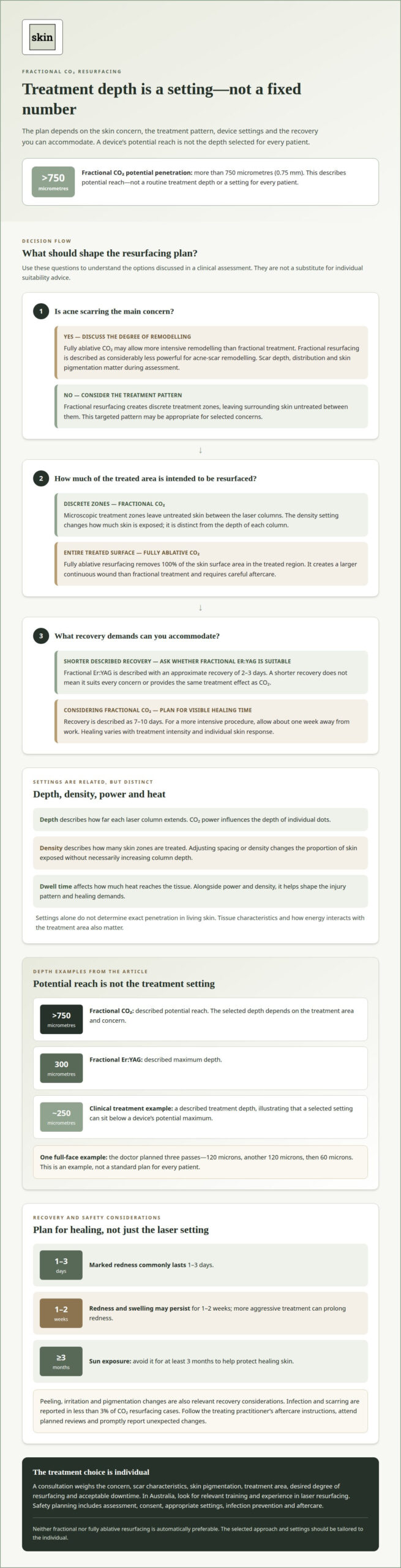
Fractional ablative CO2 resurfacing can reach more than 750 micrometres (0.75 mm), but this is a potential maximum, not a routine treatment depth. In one full-face example, the doctor planned three passes: 120 microns, another 120 microns, then 60 microns. The selected depth depends on the treatment area and concern. Fractional columns leave untreated skin between injury zones, which supports healing.
In Australia, look for a practitioner with relevant training and experience in laser resurfacing. Safety planning should include assessment, consent, appropriate settings, infection prevention and aftercare. Requirements can vary with the practitioner and treatment setting.
Recovery after fractional CO2 resurfacing is described as 7-10 days, although healing varies with treatment intensity and individual skin response. Allow about one week away from work when planning a more intensive procedure, and arrange care that lets you follow the post-treatment instructions. Skin may initially feel warm and sensitive before bronzing and peeling develop. Return to work depends on visible redness, comfort and the demands of your role.
Marked redness commonly lasts 1-3 days, while redness and swelling may persist for 1-2 weeks. More aggressive treatment can prolong redness. Peeling, irritation and changes in pigmentation are also relevant recovery considerations, particularly when skin is inflamed or exposed to sunlight. Following the clinician’s aftercare plan and avoiding sun exposure for at least 3 months helps protect healing skin.
For some concerns, fractional Er:YAG resurfacing is an alternative; its described recovery is approximately 2-3 days. That shorter recovery does not mean it suits every concern or provides the same treatment effect. The consultation should weigh the area being treated, desired degree of resurfacing and acceptable downtime before selecting a procedure. A gentler setting may suit someone prioritising a shorter visible recovery, while deeper treatment involves greater recovery demands.
Differences between fractional and fully ablative resurfacing
Fractional and fully ablative resurfacing differ in how much skin the laser treats. Fractional CO2 creates microscopic treatment zones, leaving surrounding skin untreated between them. Fully ablative CO2 resurfacing removes 100% of the skin surface area in the treated region. This distinction affects the scale of the wound and the demands of healing. An ablative laser plan therefore weighs the extent of resurfacing alongside the concern being addressed.
For acne scarring, fully ablative CO2 may allow more intensive remodelling than fractional treatment. Fractional resurfacing is described as considerably less powerful for acne scar remodelling, although its more targeted pattern can be appropriate for selected concerns. Scar depth, distribution and skin pigmentation all matter during assessment. A dermatology consultation helps establish whether the expected degree of resurfacing justifies the associated recovery and risk.
Full ablation creates a larger continuous wound than fractional treatment, so aftercare requires careful attention. Infection and scarring are reported in less than 3% of CO2 resurfacing cases. These complications remain relevant when considering treatment, particularly because healing skin needs protection and monitoring. Follow the treating practitioner’s wound-care instructions, attend planned reviews and promptly report unexpected changes. Avoid picking or rubbing the treated area while it heals.
Redness, swelling and pigment changes can affect recovery after ablative CO2 treatment. The risk of prolonged redness or altered pigmentation is part of the suitability discussion, especially for people prone to pigmentation changes. Sun protection and adherence to personalised aftercare support the healing process; the practitioner will advise how these measures apply to the treated area. Healing and visible redness vary with treatment intensity and individual response.
Fractional treatment may suit someone seeking targeted resurfacing, with untreated skin between the laser zones. Fully ablative resurfacing treats a broader area and involves a more demanding recovery; it may be considered for selected scarring concerns. Neither approach is automatically preferable. The choice depends on the scar, skin response and how much recovery time you can accommodate. A consultation can help match the approach to your treatment goals.
How device settings relate to actual penetration depth
Patients often ask how deep fractional CO2 laser goes, but a device’s maximum reach is not the depth used in every treatment. Fractional CO2 can reach more than 750 micrometres, compared with a described maximum of 300 micrometres for fractional Er:YAG.
Depth and density settings
Depth describes how far each laser column extends, while density describes how many skin zones are treated. CO2 power influences the depth of individual dots; spacing or density changes the proportion of skin exposed. These settings are related but distinct. A practitioner may adjust density while keeping individual columns shallower, changing the treated area without simply increasing penetration.
Settings alone don’t determine exact penetration in living skin. Tissue characteristics and the way energy interacts with each treatment area also matter. The density of injury is considered alongside depth when planning laser resurfacing. A described clinical treatment depth of around 250 microns illustrates how a selected treatment level can sit below a device’s potential maximum. Asking how deep fractional CO2 laser goes therefore needs an answer tied to the planned settings and skin area.
Energy settings, results and downtime
Laser power influences dot depth, while dwell time affects how much heat reaches the tissue. Together with treatment density, these settings shape the injury pattern and the skin’s healing demands. Depth and energy therefore need to be considered alongside the treatment area and concern. More tissue injury can mean greater recovery demands, so settings are selected to suit the goal and your capacity for downtime.
Depth and energy are parts of a treatment plan, not stand-alone measures of likely results. Higher settings don’t automatically produce a better outcome; excessive injury can increase tissue damage and scarring risk. Fractional CO2 and fractional Er:YAG differ in their described maximum penetration, so the appropriate option depends on the clinical goal and skin being treated.
During an assessment, the practitioner considers the target concern, treatment area, skin response and recovery needs together. This helps balance depth, energy and density for the session, rather than treating maximum penetration as the goal.
Customising laser settings to patient goals and skin type
Skin type classification is one part of assessment, not a complete description of an individual’s skin. The Fitzpatrick scale categorises how skin responds to ultraviolet exposure; fractional CO2 resurfacing is described as suitable for lighter skin types, listed as Fitzpatrick 1-111. A classification can help frame discussion, while direct examination provides information about the skin’s present condition and appearance.
The concern itself also needs careful definition. A distinct depressed scar and a broad area of uneven colour require different treatment planning, even if both affect facial appearance. Identifying the main concern helps clarify what the procedure is intended to address and which visible changes matter most to you.
Use the consultation to describe your priorities in practical terms, such as whether texture, scarring or sun-related changes concern you most. The practitioner can explain the intended treatment focus and whether the proposed approach aligns with those priorities. This helps turn a broad aim such as “rejuvenation” into a clearly defined treatment objective.
For example, if you have an acne scar and areas of uneven pigmentation, an assessment can distinguish the scar’s shape and texture from the surrounding colour variation. The treatment discussion can clarify which feature to prioritise instead of treating both concerns as the same. Skin type is relevant, but it does not replace examination of the specific feature being considered.
The key is to describe the concern you most want addressed. A clear objective gives the practitioner a meaningful basis for explaining the proposed approach, its limits and the changes it is intended to target.
Skinstitute: Fractional CO2
Skinstitute provides Fractional CO2 resurfacing for people considering treatment for concerns such as acne scarring, uneven texture or sun damage. A face-to-face consultation helps tailor the plan to your skin, treatment goals and capacity for recovery. This is the point to discuss how treatment depth and density relate to the areas being addressed, and what aftercare and downtime may involve.
Fractional CO2 may not suit every skin type or concern, so the assessment also considers suitability and potential risks. The aim is a clinically considered approach, rather than selecting the deepest setting by default. You can contact Skinstitute to discuss whether Fractional CO2 may be appropriate for your skin concerns.
Make your next step an informed one
Before a treatment discussion, decide what you want clarified. You might ask whether a particular mark is the main concern, what visible change matters to you, or how recovery could affect your routine. Bringing one or two priorities to the conversation can make it more specific and help you understand the reasoning behind a proposed plan.
Knowing how deep fractional CO2 laser goes can provide context, but a maximum figure cannot tell you what is appropriate for your skin. The more useful measure is whether the planned approach addresses the concern you identified while respecting your preferences and circumstances. If those points remain unclear, take time to consider them before deciding.
There’s no need to rush your decision. A considered choice is one you understand, including its purpose and limits. Clear priorities can help you weigh the information calmly and decide whether the proposed treatment suits your needs.
Frequently Asked Questions
Is laser treatment safe?
Fractional CO2 laser treatment has risks, so safety depends on appropriate assessment, treatment settings and aftercare. A practitioner considers your skin characteristics, medical history, treatment area and goals before deciding whether to proceed. Discuss previous skin reactions and your capacity for recovery during consultation. No laser procedure is risk-free, and suitability depends on the individual circumstances and planned treatment.
Are there any side effects?
Yes. Redness, swelling, sensitivity, bronzing and peeling can occur as treated skin heals. Changes in pigmentation are also a consideration, particularly if skin is prone to discolouration after inflammation. Infection and scarring are reported in less than 3% of CO2 resurfacing cases. Follow the practitioner’s aftercare instructions, and contact the treating clinic about unexpected changes during healing.
Can all areas of the body be treated and does skin colour make a difference?
No, treatment suitability depends on the area and the skin being assessed. Facial resurfacing is a common application, while other areas require consideration of their skin characteristics and healing response. Skin colour matters because pigmentation risk can influence treatment planning. Fractional CO2 resurfacing is described as suitable for lighter skin types, listed as Fitzpatrick 1-111; assessment remains individual.
How many microns deep or passes are typically done with CO2 laser?
There is no single standard depth or pass count for every treatment. One full-face example used passes of 120 microns, 120 microns and 60 microns. This illustrates a planned treatment, not a typical prescription. The laser’s described maximum penetration exceeds 750 micrometres (0.75 mm), but that figure is not the depth selected for every patient.
How does the treatment work?
A fractional CO2 laser delivers energy in a pattern of small treatment zones, creating controlled injury that prompts a healing response. The resurfacing laser operates at a wavelength of 10,600 nanometres. Untreated skin between fractional zones supports the repair process. The practitioner selects the pattern and settings according to the area and concern, rather than treating all skin uniformly.
How long is the recovery following CO2 laser resurfacing?
Recovery after fractional CO2 resurfacing is described as 7-10 days, but visible redness and swelling can last 1-2 weeks. Some people may need around one week away from work, depending on treatment intensity and their role. Healing is not complete simply because peeling settles. Plan around your work and social commitments, and follow the treating practitioner’s aftercare guidance.