Fractional Laser for Sun Damage in Melbourne
September 6, 2026
Fractional CO2 Laser Cost Melbourne: A Clinical Pricing and Value Guide
September 8, 2026
The final aesthetic outcome of a laser procedure is determined less by the device itself and more by the precision of your biological management during the inflammatory phase. Many patients approach their laser skin resurfacing recovery timeline with a sense of trepidation, fearing that the initial redness or peeling signifies a permanent complication rather than a necessary regenerative milestone. This anxiety often stems from a lack of technical clarity regarding how the dermis reorganises itself after controlled thermal injury. It’s an understandable concern, particularly when you’re balancing the desire for significant texture improvement with the practicalities of social and professional obligations.
We recognise that managing the post-procedure period requires more than just patience; it demands a structured, medical-grade approach to wound healing. This guide provides a clinical day-by-day breakdown of the physiological transitions your skin undergoes, from the immediate inflammatory response to the long-term synthesis of new collagen fibres and dermal remodelling. You’ll learn which active ingredients to avoid, how to manage swelling effectively, and what steps are essential to ensure your results are both safe and transformative. By understanding the science of epithelial repair, you can move through your recovery with confidence and clinical certainty.
Key Takeaways
- Understand the three distinct biological phases of repair—Inflammatory, Proliferative, and Remodelling—to better manage your skin’s healing trajectory.
- Navigate the laser skin resurfacing recovery timeline by identifying the transition from the initial “bronzed” stage to active re-epithelialisation during the first week.
- Learn why residual pinkness, or erythema, is a clinical indicator of active collagen synthesis and how to protect the maturing skin barrier during this phase.
- Identify how individual variables, such as your position on the Fitzpatrick Skin Scale and your metabolic health, influence the speed and safety of cellular turnover.
- Discover how advanced regenerative therapies like Rejuran and Exosomes can be integrated to provide the essential building blocks for optimised dermal repair.
Understanding the Laser Skin Resurfacing Recovery Timeline
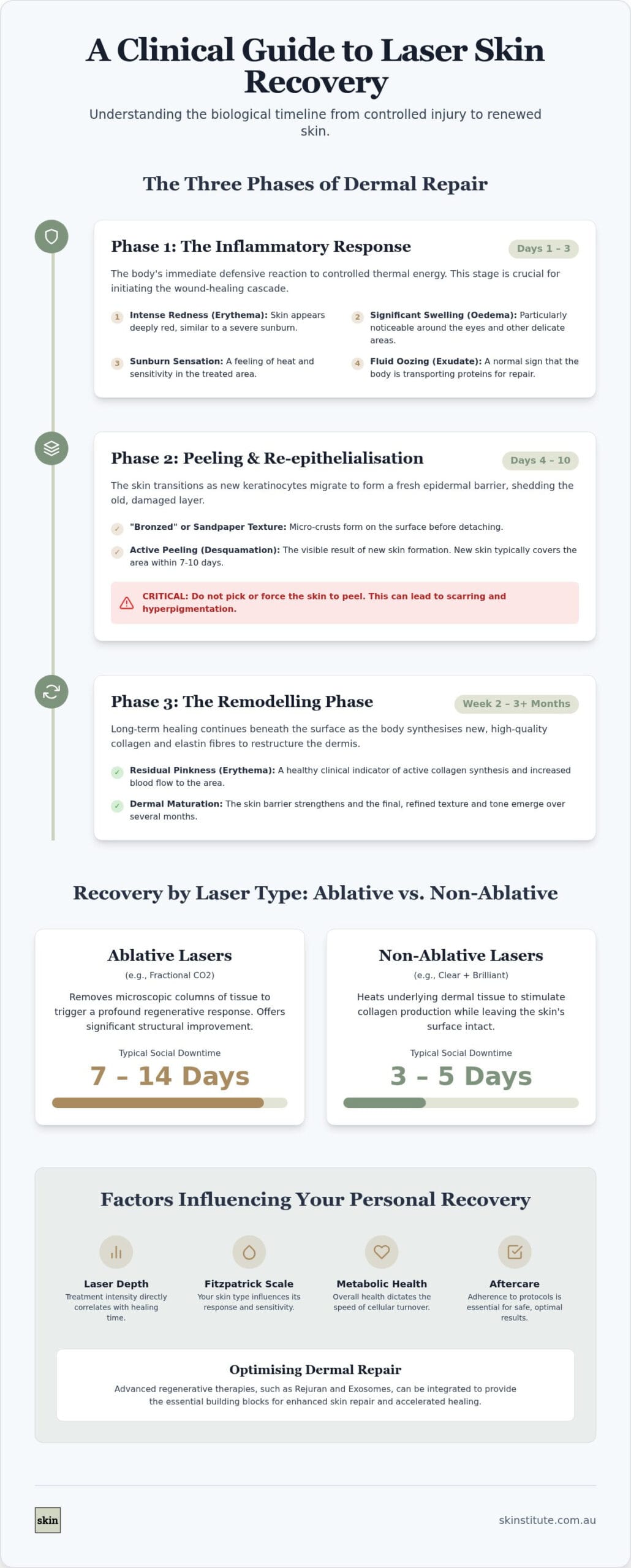
Recovery after a laser procedure is a meticulously orchestrated biological sequence rather than a simple period of inactivity. To accurately navigate the laser skin resurfacing recovery timeline, one must understand that the skin undergoes three distinct phases: the inflammatory phase, the proliferative phase, and the remodelling phase. These stages represent the body’s transition from immediate wound protection to the synthesis of new dermal structures. The fundamental principle of photorejuvenation involves creating a controlled thermal injury to trigger a massive regenerative response, essentially compelling the skin to replace damaged tissue with high-quality collagen and elastin fibres.
It’s vital to distinguish between social downtime and biological healing. Social downtime typically refers to the period of visible peeling and crusting that may prevent participation in public or professional activities. Biological healing, however, encompasses the internal processes that continue long after the surface has healed, such as persistent erythema and ongoing dermal maturation. The ultimate goal of this controlled injury is to reset the skin’s cellular clock, leading to a more refined texture and improved structural integrity.
The Immediate Inflammatory Response (Days 1–3)
During the first 72 hours, the skin initiates its defensive response to the thermal energy. Patients frequently describe a sensation akin to a severe sunburn, often accompanied by significant oedema, or swelling, particularly around the periorbital area. This phase may also involve the presence of exudate, a fluid that oozes from the treated zones. While this can be unsettling, it is a natural component of the wound-healing cascade, signifying that the body is transporting essential proteins and white blood cells to the site of repair. Erythema is the clinical term for the intense redness observed during this immediate post-laser period.
Ablative vs. Non-Ablative: Timeline Differences
The duration of the laser skin resurfacing recovery timeline depends heavily on the specific technology utilised. Fractional CO2 lasers, which are ablative, involve the removal of columns of tissue, typically requiring a 7 to 14-day recovery period as the skin undergoes re-epithelialisation. In contrast, non-ablative lasers leave the skin surface intact, resulting in a much shorter proliferative phase of 3 to 5 days. The depth of laser penetration directly dictates how long the body requires to rebuild the epidermal barrier. Many Melbourne patients opt for fractional technology because it strikes a precise balance, delivering the profound structural improvements of ablative therapy with a more manageable period of social downtime compared to traditional fully ablative methods.
Phase One: The Peeling and Re-epithelialisation Stage (Days 4–7)
By the fourth day, the skin’s appearance typically transitions from an intense erythema to a “bronzed” or sandpaper-like texture. This shift marks a critical juncture in the laser skin resurfacing recovery timeline where the micro-crusts of coagulated tissue begin to detach. This process, known as desquamation, is the visible result of re-epithelialisation. Beneath the old, damaged layer, new keratinocytes are rapidly migrating to form a fresh epidermal barrier. It’s essential to allow this process to occur at its own biological pace. Forcing the skin to peel prematurely can expose immature cells, significantly increasing the risk of infection and post-inflammatory hyperpigmentation (PIH).
Clinical observation shows that new skin generally covers the treated area within 7 to 10 days for most patients. This timeline is consistent with the physiological data provided in the Mayo Clinic’s guide to laser resurfacing. We maintain a strict “no picking” protocol during this window. Any mechanical disruption of the peeling skin can lead to micro-scarring or uneven pigment distribution, undermining the results of the procedure.
Step-by-Step Care During Active Peeling
Hygiene must be meticulous but gentle. Cleanse the skin twice daily using a soap-free, non-foaming cleanser, applying it with light, circular motions and rinsing with lukewarm water. Avoid using washcloths or abrasive sponges. After cleansing, apply a thick layer of a medical-grade occlusive ointment. These ointments maintain a moist wound environment, which is proven to facilitate faster cellular migration and reduce the risk of scab formation. If you notice any focal areas of intense heat, yellow crusting, or persistent oozing, a clinical assessment is necessary to rule out bacterial or viral complications.
Managing Itching and Sensitivity
Pruritus, or itching, often peaks between days five and seven. This sensation is a byproduct of regenerating nerve endings and the temporary loss of the skin’s natural lipid barrier. To manage this discomfort, use sterile thermal water mists or cool, damp compresses to soothe the area. You must strictly avoid all active skincare ingredients during this stage. Substances such as Retinol, Vitamin C, and exfoliating acids are far too aggressive for the compromised epidermis and can cause severe chemical irritation. Reintroducing these products too early can stall the healing process and lead to prolonged redness. Stick to basic, dermatologist-approved emollients until the skin is no longer peeling.
Phase Two: The Pink Phase and Erythema Management (Week 2 to Month 3)
Once the active peeling process concludes, typically by the end of the first week, the skin enters a prolonged state of erythema. This pinkish hue is a fundamental component of the laser skin resurfacing recovery timeline. It indicates neovascularisation and increased blood flow to the treatment area, which are essential for delivering the nutrients and oxygen required for intensive tissue repair. While the intensity of the colour will gradually diminish, it’s common for a subtle rosy tone to persist for several weeks or even months, depending on the depth of the laser penetration and the individual’s natural healing rate.
Around the second or third week, many patients notice the “glow” phase. Although the skin remains pink, the underlying texture appears significantly smoother and more refined as the new epidermis matures. It’s generally safe to resume a more standard skincare routine during this period, provided the products are non-irritating and focus on barrier support. However, managing expectations is vital. The lingering pinkness can sometimes be frustrating, but it’s helpful to view this erythema as a visual confirmation that the skin is actively synthesising new structural proteins and remains in a highly regenerative state.
Collagen Remodelling: The Long-Term Benefit
The biological shifts occurring during this phase are profound and move beyond surface-level aesthetics. Initially, the body produces Type III collagen, a structural protein associated with rapid wound healing. Over the subsequent months, this is gradually replaced by Type I collagen, which is more robust and provides the skin with its characteristic strength and elasticity. Because of this slow transition, the final aesthetic results of a Fractional CO2 laser resurfacing Melbourne treatment are not fully realised for three to six months. Dermal remodelling continues deep within the tissue long after the surface has appeared to heal, leading to progressive improvements in skin laxity and scar tissue.
Sun Protection in the Australian Climate
In the harsh Melbourne environment, protecting the maturing epidermis is the most critical factor in preventing post-inflammatory hyperpigmentation (PIH). We mandate a strict protocol of broad-spectrum SPF 50+ application every day, regardless of cloud cover. Physical blockers containing Zinc Oxide or Titanium Dioxide are preferred over chemical filters, as they sit on the surface and reflect UV radiation without causing potential chemical irritation to the sensitive new skin. Supplementing sunscreen with wide-brimmed hats and avoiding direct sun exposure during peak UV hours is essential for maintaining the integrity of your results. If you have concerns about persistent redness, our clinicians can provide a professional consultation to ensure your recovery is progressing according to clinical standards.
Clinical Factors That Influence Your Personal Recovery
The biological response to laser energy is never uniform; it is dictated by a complex interplay of genetic and environmental variables. While the laser skin resurfacing recovery timeline provides a clinical framework, your personal healing velocity is heavily influenced by your baseline metabolic health and age. As we age, the rate of cellular mitosis and the efficiency of the wound-healing cascade naturally diminish, which can extend the time required for the skin to fully re-epithelialise. Lifestyle factors exert a similar influence on the inflammatory response. Smoking is particularly detrimental, as it induces vasoconstriction and compromises oxygen delivery to the newly treated dermal layers, potentially stalling the transition to the proliferative phase. Alcohol consumption also interferes with the resolution of oedema, often leading to prolonged swelling in the immediate post-procedure window.
The specific parameters of the laser treatment, namely the energy density and pulse duration, are calibrated by your practitioner to balance efficacy with safety. Higher energy levels used for deep structural correction will naturally result in a more intense inflammatory response compared to superficial resurfacing. This customisation ensures that the thermal injury is sufficient to trigger regeneration without exceeding the skin’s capacity for repair.
Fitzpatrick Skin Types and PIH Risk
Patients with darker skin tones, specifically those falling within Fitzpatrick IV to VI, require a highly specialised approach to prevent post-inflammatory hyperpigmentation (PIH). In these skin types, the melanocytes are more reactive to thermal stimuli, which can lead to irregular pigment deposition if the laser intensity is not meticulously controlled. We often implement a pre-treatment protocol involving tyrosinase inhibitors to stabilise pigment production before the procedure. A comprehensive Skinstitute assessment is essential for these patients to ensure that the chosen laser settings are safe for their specific phototype while still achieving the desired regenerative outcome.
Preparation: Reducing the Downtime Before You Start
Effective recovery begins before the laser touches the skin. For individuals with a history of cold sores, the administration of prophylactic antivirals is a mandatory safety measure to prevent viral activation during the vulnerable re-epithelialisation stage. We also recommend pre-conditioning the skin with medical-grade Vitamin A or specific barrier-strengthening topicals for several weeks prior to treatment. This preparation ensures the dermis is primed for repair and can significantly reduce the duration of social downtime. Maintaining optimal hydration and protein intake in the lead-up to your appointment provides the essential building blocks for rapid tissue synthesis. If you are ready to begin your journey, you can book a clinical consultation to develop a personalised preparation protocol.
Accelerating Regeneration: The Skinstitute Melbourne Approach
Integrating bio-stimulators into the laser skin resurfacing recovery timeline represents a significant advancement in aesthetic medicine. At Skinstitute, we don’t merely wait for the skin to heal; we actively provide the cellular environment with the resources required to optimise repair. By utilising professional-grade LED Light Therapy in the immediate post-procedure phase, we can effectively modulate the inflammatory response. Red and yellow wavelengths penetrate the tissue to stimulate mitochondrial activity and enhance local circulation, which assists in the rapid reduction of erythema and oedema. This proactive management ensures that the initial thermal energy of the laser is harnessed for regeneration rather than prolonged irritation.
This clinical approach moves beyond surface-level care to address the biological foundations of wound healing. By intervening early in the inflammatory cycle, we can influence the quality of the final remodelling phase. This ensures that the new tissue is not only formed quickly but is of the highest structural integrity, reflecting our commitment to technical mastery and patient safety in the Melbourne clinical environment.
Rejuran and Exosomes: Enhancing the Laser Result
The synergy between thermal resurfacing and regenerative bio-stimulation is profound. While the laser creates the structural impetus for change, Rejuran Melbourne treatments introduce polynucleotides to actively repair damaged cellular structures. These polynucleotides act as essential building blocks, assisting in the restoration of DNA and accelerating the synthesis of high-quality collagen. Similarly, Exosomes deliver a concentrated payload of growth factors and signalling molecules directly to the treated zones. By providing these essential components, we can often shave several days off the social downtime phase, allowing the epidermis to reach a stable state of re-epithelialisation much faster than through natural healing alone.
Customised Aftercare Protocols
Generic, over-the-counter moisturisers are often insufficient for the complex needs of a skin barrier undergoing medical-grade resurfacing. These products frequently lack the necessary lipid ratios or contain fragrances that can trigger contact dermatitis during the vulnerable recovery window. Our clinical approach involves a structured follow-up appointment at Day 3 or Day 7 to monitor the progression of the new epidermis and adjust the occlusive protocol as needed. Once the barrier is fully restored and the peeling has ceased, we guide our patients through a methodical transition back to their long-term anti-ageing regime. This ensures that potent actives like Retinoids are reintroduced only when the dermal structures are sufficiently resilient to tolerate them. By combining 26 years of technical mastery with these advanced regenerative tools, Skinstitute remains the established Melbourne authority for patients seeking safe, evidence-based aesthetic outcomes.
Securing Long-Term Dermal Integrity
Navigating the laser skin resurfacing recovery timeline is a process that demands clinical precision rather than simple patience. By understanding the biological shifts from initial re-epithelialisation to long-term collagen remodelling, you can manage your skin for optimal results. Our clinic provides the stability of over 26 years of aesthetic medicine experience, utilising advanced Fractional CO2 technology to deliver transformative outcomes. We prioritise safety through expert clinical guidance on regenerative aftercare, ensuring your barrier remains protected throughout every phase of repair.
If you’re prepared to invest in the long-term health of your skin, Book a Clinical Skin Analysis at our Melbourne Clinic. Our practitioners are here to guide you through a structured and predictable healing journey. You can look forward to a more refined texture and a restored complexion with the assurance of professional medical oversight and a commitment to technical excellence.
Frequently Asked Questions
How long do I need to take off work after Fractional CO2 laser?
Social downtime for Fractional CO2 usually ranges from 7 to 10 days. During this window, the skin undergoes active peeling and re-epithelialisation, which most patients prefer to manage in a private environment. The exact duration depends on the energy density and depth of the treatment administered at our Melbourne clinic. While you can technically work from home after the first 48 hours, the visible “bronzed” and peeling stages are most prominent between days four and seven.
Can I wear makeup during the laser skin resurfacing recovery timeline?
You must avoid applying makeup until the skin has fully re-epithelialised, which typically occurs by day 10 of the laser skin resurfacing recovery timeline. Applying cosmetics to a compromised skin barrier introduces a high risk of bacterial infection and chemical irritation. Once the peeling has ceased and the new epidermis is stable, mineral-based makeup is preferred. This allows the skin to breathe while providing a physical layer of protection against environmental pollutants during the sensitive pink phase.
Is it normal for my skin to look like a “grid” or “pixelated” after treatment?
A pixelated or “grid-like” appearance is a standard clinical outcome of fractional technology. This pattern represents the Microscopic Treatment Zones where the laser beam has precisely ablated columns of tissue while leaving the surrounding skin intact to facilitate faster healing. These tiny dots will eventually darken into micro-crusts and flake away naturally during the first week. It’s a sign that the treatment was delivered with the correct density to trigger a regenerative response.
When can I resume exercise and heavy sweating post-laser?
We recommend avoiding strenuous exercise and heavy sweating for at least 7 to 14 days post-laser. Elevated body temperature and salt from perspiration can cause intense stinging, increased swelling, and potential irritation of the immature epidermis. Gym environments are often high in bacteria, which poses a risk to your healing skin. You may resume light walking once the initial inflammatory phase has subsided, but high-intensity workouts should wait until the skin barrier is fully restored.
How do I sleep to minimise swelling after my facial laser treatment?
Sleeping with your head elevated on two or three pillows is essential for the first 48 to 72 hours. This positioning utilises gravity to reduce the accumulation of fluid in the facial tissues, which significantly minimises post-laser oedema. You should also attempt to sleep on your back to prevent any mechanical friction or pressure on the treated areas. Reducing nocturnal swelling in the early stages of the laser skin resurfacing recovery timeline helps to accelerate the transition to the proliferative phase.
What should I do if I notice small white bumps (milia) during recovery?
If you notice milia, or small white bumps, do not attempt to extract them yourself. These often occur when the heavy, occlusive ointments required for wound healing temporarily trap keratin in the developing pores. At our Melbourne clinic, we can safely manage these during a follow-up appointment if they persist. Most milia resolve spontaneously once you transition from thick ointments to lighter, medical-grade moisturisers after the first week of healing is complete.
Can I use Vitamin C or Retinol during the first week of healing?
Active ingredients like Vitamin C and Retinol must be strictly avoided during the first week of recovery. These substances are designed to penetrate deeply and are far too aggressive for the delicate, newly formed epidermis. Reintroducing them prematurely can lead to chemical burns, prolonged erythema, or post-inflammatory hyperpigmentation. Most patients can safely resume these actives between week three and week six, but this should only occur after a clinical assessment of your skin barrier’s resilience.
Will my skin stay pink forever after a deep laser resurfacing?
Persistent pinkness, or erythema, is a temporary phase that typically resolves within one to three months. This hue is a clinical sign of increased vascular activity and active collagen synthesis within the dermis. While it may feel lingering, it’s a necessary part of the remodelling process. Protecting the area from the Melbourne sun with SPF 50+ is vital during this time, as UV exposure can darken the pinkness into permanent pigment changes if the skin is left unprotected.