Non-Surgical Skin Tightening Melbourne: A Clinical Guide to Medical-Grade Rejuvenation
August 22, 2026
The Clinical Guide to Dermal Fillers in Melbourne: A Science-Led Approach
August 24, 2026
Topical serums often fail to reach the deeper dermal layers where structural ageing occurs, making them a surface-level solution for a deep-seated biological issue. If you’re seeking a co2 laser for wrinkles melbourne, you’ve likely realised that significant loss of elasticity cannot be reversed by over-the-counter products alone. It’s a common frustration to see perioral and periocular lines continue to deepen despite a dedicated skincare routine, as these changes are driven by a fundamental breakdown of collagen and elastin fibres.
This guide explores the medical-grade science of fractional CO2 laser technology, which acts as a controlled biological reset to restructure your skin’s internal matrix. By understanding how this gold standard treatment leverages your body’s innate regenerative capacity, you can move beyond temporary fixes toward genuine dermal restoration. We’ll examine the technical mechanics of fractional resurfacing, the clinical reality of the three to seven day recovery period, and how dermal remodelling provides long-term results for even the most stubborn texture concerns.
Key Takeaways
- Understand the clinical mechanics of the 10,600nm wavelength and how it initiates a biological reset by restructuring the dermal matrix.
- Discover how fractional technology and Micro-Ablative Columns (MACs) make the co2 laser for wrinkles melbourne a highly precise intervention with manageable downtime.
- Learn to differentiate between the results of ablative resurfacing and alternative treatments like HIFU or prescription injectables for various types of facial lines.
- Identify the essential pre-treatment protocols, including the use of tyrosinase inhibitors, required to ensure safety and optimal pigment response.
- Explore how the integration of bio-stimulatory treatments like Rejuran can be used to accelerate the healing process and enhance long-term structural integrity.
The Clinical Science of Wrinkles and the CO2 Standard
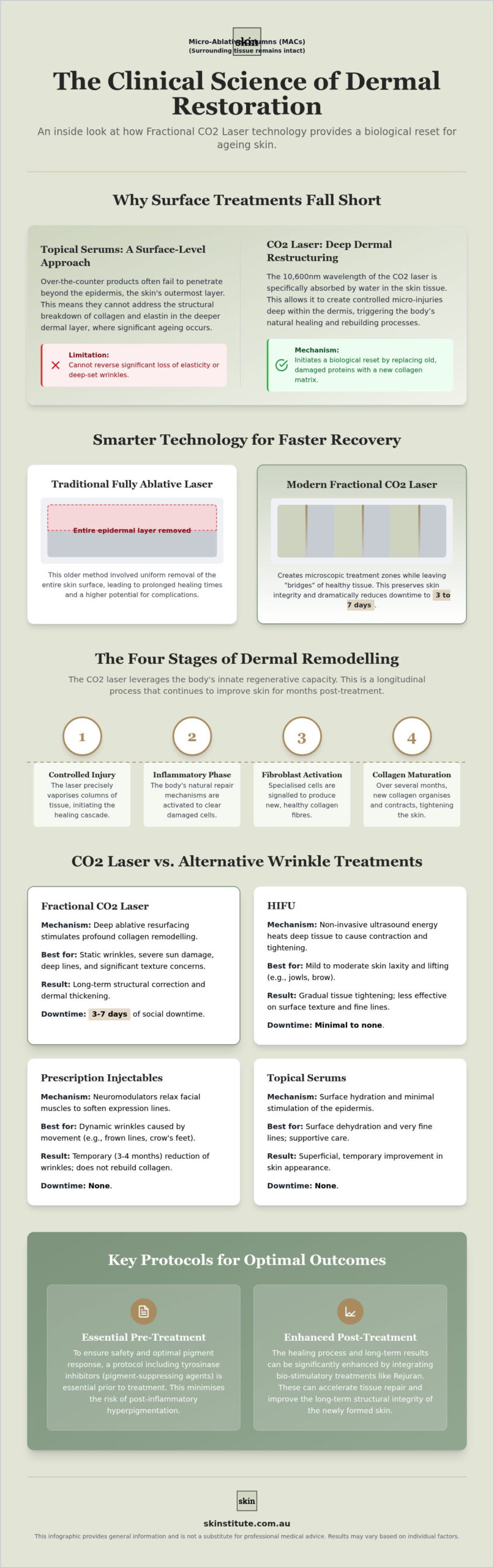
The carbon dioxide (CO2) laser operates at a specific infrared wavelength of 10,600nm, targeting water molecules within the skin tissue to achieve precise ablation. As a clinical standard, co2 laser for wrinkles melbourne provides a level of structural correction that lighter, non-ablative modalities cannot replicate. Static wrinkles, also known as deep rhytids, are the physical manifestation of a compromised dermal matrix where collagen and elastin fibres have undergone significant degradation over time. The science of laser resurfacing highlights how this technology remains the gold standard for treating deep-seated solar elastosis and structural skin laxity by delivering high-intensity energy to the deeper layers of the integumentary system.
Ablative resurfacing is often necessary because non-ablative alternatives, while requiring less downtime, simply don’t provide the same degree of tissue contraction or dermal thickening. For patients with established lines around the mouth or eyes, the goal is a biological reset that replaces old, damaged proteins with a fresh, organised matrix. This process requires a practitioner to precisely manage energy settings to ensure the laser reaches the appropriate depth while maintaining a high safety profile.
Biological Mechanisms of Dermal Remodelling
The procedure initiates a controlled thermal injury, which triggers a cascading inflammatory healing phase. This response is the body’s natural mechanism for repair. During this period, specialised cells called fibroblasts are activated. These cells are responsible for synthesising new Type I and Type III collagen, the essential proteins that provide skin with its tensile strength and elasticity. This focus on fibroblast stimulation is shared by other advanced aesthetic technologies, such as the plasma pen devices developed by Jett Medical Canada, which offer non-surgical alternatives for skin tightening and rejuvenation. This isn’t an overnight change. Collagen maturation is a longitudinal process. Over several months, the newly formed fibres undergo a process of organisation and contraction, resulting in a tighter, more resilient skin surface that continues to improve long after the initial treatment.
Ablative vs. Non-Ablative: Why Depth Matters
Depth is the defining factor in clinical efficacy. While non-ablative lasers deliver heat without removing tissue, they often fail to reach the reticular dermis where deep wrinkles originate. Ablative CO2 energy physically vaporises columns of damaged tissue, creating a more profound regenerative stimulus than surface-level treatments. By penetrating these deeper layers, the co2 laser for wrinkles melbourne addresses the root cause of skin sag and deep lines. This ensures the biological reset is thorough rather than superficial, providing a foundation for long-term structural improvement that topical serums or lighter lasers cannot achieve.
How Fractional Technology Minimises Downtime
The evolution from fully ablative to fractional technology represents a significant advancement in dermatological science. Traditional CO2 resurfacing involved the uniform removal of the entire epidermal layer, which resulted in prolonged healing times and a higher incidence of complications. In contrast, modern fractional systems deliver energy in a pixelated pattern. This creates thousands of microscopic treatment zones, known as Micro-Ablative Columns (MACs), while leaving the surrounding tissue entirely intact. This mosaic approach ensures that the skin’s structural integrity is maintained throughout the regenerative process.
These untreated “bridges” of skin play a critical role in the recovery process. Because the surrounding cells are healthy and viable, they can rapidly migrate into the MACs to initiate re-epithelialisation. This biological shortcut significantly reduces downtime, typically limiting it to three to seven days depending on the intensity of the settings. According to a clinical review of ablative laser resurfacing, this approach also lowers the risk of long-term side effects such as permanent hypopigmentation or scarring, which were more prevalent with older, non-fractionated methods. By preserving these healthy tissue reservoirs, the body can focus on deep dermal repair without the burden of healing a completely open wound.
The Mathematical Precision of Laser Settings
Achieving optimal results with a co2 laser for wrinkles melbourne requires meticulous adjustment of treatment parameters. Density refers to the percentage of skin surface covered by the MACs, while energy levels determine the depth of penetration into the dermis. High-density settings are often utilised for severe solar damage, whereas lower density may be appropriate for general texture refinement. Another critical factor is “dwell time,” which is the duration the laser pulse remains on a single spot. Controlling dwell time allows a practitioner to manage thermal spread, ensuring that heat is delivered precisely to stimulate collagen without causing excessive collateral damage to the surrounding tissue. This level of technical precision is seen across various medical fields; for instance, Illinois Podiatry Specialists utilise specialised laser and shockwave therapies to treat complex podiatric conditions, demonstrating the versatile nature of these regenerative technologies.
Safety Profiles for Different Skin Phototypes
Safety is paramount, particularly when treating patients with darker skin tones (Fitzpatrick scales IV-VI). These individuals have a higher risk of developing post-inflammatory hyperpigmentation (PIH) if the inflammatory response is too aggressive. Risk mitigation strategies include the use of test patches and pre-treatment priming with specific tyrosinase inhibitors to stabilise melanocyte activity. By following these rigorous clinical protocols, practitioners at Skinstitute ensure that high-intensity laser treatments remain a viable and safe option for a diverse range of skin types. This methodical approach prioritises long-term skin health over immediate, aggressive results, providing a secure pathway for those seeking effective correction of deep-set lines.
CO2 Laser vs. Alternative Wrinkle Treatments
Selecting the most effective clinical modality requires an accurate assessment of whether the primary concern is structural laxity, dynamic movement, or static dermal damage. While many patients researching a co2 laser for wrinkles melbourne are looking for a comprehensive solution, it’s vital to understand how this technology sits within the broader landscape of aesthetic medicine. Unlike skin needling, which provides a mechanical stimulus for collagen induction, the CO2 laser delivers high-intensity thermal energy that vaporises damaged tissue. While needling is an excellent maintenance tool for general skin health, it rarely achieves the transformative results required for deep rhytids or significant solar elastosis.
From a clinical perspective, the cost-benefit ratio of CO2 resurfacing is often superior to milder treatments. While a single CO2 session involves a higher initial investment and a dedicated recovery period, it frequently achieves results that would require six to ten sessions of less intensive modalities. The patient’s guide to laser resurfacing provides further clarity on how these ablative systems provide a level of dermal remodelling that non-invasive alternatives cannot match. For those with established age-related changes, the “one-and-done” nature of a high-intensity laser session is often more practical than the cumulative time and expense of multiple low-level appointments.
CO2 Laser and Prescription Injectables: A Synergistic Approach
Clinical outcomes are often enhanced when different treatments are used in tandem to address separate biological processes. Prescription injectables are the gold standard for dynamic lines—those caused by repetitive muscle contractions during facial expression. However, once these lines become “static” and remain visible at rest, muscle relaxation alone is insufficient. In these cases, we utilise injectables to stabilise the underlying muscle activity and CO2 laser to repair the etched dermal matrix. A total face rejuvenation plan typically involves administering injectables several weeks before or after the laser procedure to ensure the newly synthesised collagen isn’t immediately subjected to mechanical stress.
HIFU vs. CO2: Surface Texture vs. Structural Lift
It’s important to distinguish between the need for a “lift” and the need for “resurfacing.” High Intensity Focused Ultrasound (HIFU) targets the SMAS layer, the deep foundational tissue responsible for structural support. It’s designed to lift sagging contours but does little to improve surface texture or fine lines. Conversely, the co2 laser for wrinkles melbourne focuses on the epidermis and the dermis to eliminate wrinkles and pigmentation. Many patients benefit from a combined approach where HIFU provides the foundational tightening and CO2 provides the surface refinement, addressing both the architecture and the envelope of the skin.
The Melbourne Patient Journey: Consultation to Recovery
The journey toward dermal restoration begins with a comprehensive clinical skin analysis at our Melbourne centre. During this initial phase, we conduct a thorough medical history review and assess the depth of rhytids to determine if a co2 laser for wrinkles melbourne is the most appropriate intervention for your specific skin concerns. Following this assessment, patients enter a mandatory priming phase. This involves the use of specific tyrosinase inhibitors for two to four weeks prior to the procedure. This preparation is essential to stabilise melanocyte activity, particularly in the variable Australian climate, to reduce the risk of post-inflammatory pigmentary changes.
On the day of the procedure, a high-strength topical anaesthetic is applied to the treatment area to ensure patient comfort. The laser experience involves the systematic delivery of fractionated energy across the target zones. While patients typically feel a sensation of intense heat, the precision of modern systems ensures a predictable and controlled outcome. Immediately following the session, the acute recovery phase begins as the skin initiates its innate inflammatory response to the thermal stimulus.
Managing the “Downtime” Reality
Clinical recovery follows a structured progression that patients should anticipate. On days one and two, the skin typically exhibits significant erythema and oedema, similar to the sensation of a severe sunburn. By day three, the skin begins to “bronze” as the microscopic treatment zones migrate toward the surface. Peeling generally occurs between days four and seven. It’s important to distinguish between functional downtime, where you’re physically able to perform daily tasks, and social downtime, where the visible peeling may lead you to defer public or professional engagements. We provide essential post-care topical agents, such as specialised occlusive balms, to maintain the skin’s moisture barrier and support rapid re-epithelialisation.
Environmental Factors: Laser Resurfacing in the Melbourne Climate
The high UV index in Victoria presents a unique challenge for post-laser recovery. We generally recommend scheduling a co2 laser for wrinkles melbourne during the autumn or winter months when ambient UV levels are at their lowest. Direct sun exposure must be strictly avoided for at least three months following the procedure, as the newly formed tissue is highly vulnerable to UV-induced damage. Effective Melbourne-grade protection requires the diligent application of broad-spectrum SPF 50+ alongside environmental barrier creams to shield the skin from both radiation and wind-driven dehydration. To begin your clinical skin assessment and develop a customised preparation plan, we invite you to book a consultation at our Melbourne clinic today.
The Skinstitute Clinical Approach to Resurfacing
With over 26 years of industry experience, Skinstitute has established itself as a clinical leader in medical-grade aesthetic technology. We don’t view fractional resurfacing as an isolated procedure. It’s a core component of a broader, holistic regenerative strategy. By integrating bio-stimulatory treatments such as Rejuran, we can significantly enhance the biological healing phase. These polynucleotides provide the necessary building blocks for cellular repair, working alongside the laser’s thermal stimulus to accelerate tissue recovery and improve skin quality. We also incorporate exosomes into our protocols to further modulate the inflammatory response and optimise the structural outcome. This multi-layered approach ensures that the co2 laser for wrinkles melbourne provides more than just a surface-level change.
Why Clinical Experience Matters for High-Energy Lasers
High-energy laser systems require a high degree of technical proficiency and clinical judgment. The risks associated with “discount” laser clinics are substantial. Improperly calibrated settings or inexperienced operators can lead to adverse events such as thermal burns, scarring, or permanent pigmentary changes. Our commitment to safety is rooted in evidence-based protocols and rigorous clinical standards. Every patient’s journey is supported by bespoke follow-up care and precise monitoring. We take the time to explain the “why” behind every parameter adjustment, ensuring you feel respected and informed. This level of oversight is a hallmark of a practitioner-led environment, providing a reassuring sense of stability that high-street spas cannot replicate.
Beyond Wrinkles: Addressing Texture and Scarring
While the focus is often a co2 laser for wrinkles melbourne, the technology offers significant secondary benefits for complex skin issues. It’s a highly effective modality for treating atrophic acne scarring and achieving visible pore refinement. The fractional CO2 laser resurfacing Melbourne is also instrumental in managing sun-damaged skin, specifically addressing actinic keratosis. This dual action: improving structural integrity while removing precancerous surface damage, makes it an essential tool for long-term skin health in the Australian environment. By vaporising damaged columns of tissue, the laser encourages the growth of healthy, organised cells. We invite you to book a professional analysis to develop a tailored rejuvenation plan that addresses your unique dermal profile and aesthetic goals.
Advancing Your Dermal Restoration Strategy
Fractional CO2 resurfacing remains the definitive clinical intervention for those seeking a biological reset of the dermal matrix. By leveraging the body’s innate healing response through the 10,600nm wavelength, this technology provides structural correction that topical solutions cannot achieve. Selecting a co2 laser for wrinkles melbourne requires a commitment to clinical excellence and a thorough understanding of the necessary pre-treatment protocols and post-care requirements.
At Skinstitute, our approach is underpinned by over 26 years of aesthetic industry experience and a dedication to using medical-grade fractional CO2 technology. Our expert clinical practitioners prioritise your safety and long-term results, ensuring every treatment parameter is precisely calibrated to your unique skin phototype. Whether you’re addressing deep rhytids or complex texture issues, we provide the authoritative guidance needed for a successful regenerative journey.
We invite you to take the next step in your skin health. Book your clinical skin analysis at Skinstitute Melbourne today to begin a customised restoration plan. We look forward to partnering with you on your path to dermal resilience.
Frequently Asked Questions
How long do the results of CO2 laser for wrinkles last?
Results typically persist for several years because the procedure induces a permanent structural change in the dermal matrix. While the newly synthesised collagen remains in the skin, the biological ageing process continues alongside environmental factors like UV exposure. Most patients maintain their clinical improvements for three to five years. Sustaining these outcomes requires a rigorous maintenance regime involving high-standard sun protection and medical-grade skincare to protect the integrity of the restructured tissue.
Is fractional CO2 laser resurfacing painful?
Patient comfort is managed through the application of high-strength topical anaesthesia prior to the procedure. During the session, you may experience a sensation of intense heat or a prickling feeling as the laser creates microscopic treatment zones. Most individuals find the experience tolerable within a clinical setting. Post-treatment, the skin feels similar to a significant sunburn for the first twenty-four to forty-eight hours, which is managed with cooling protocols and occlusive balms.
What is the typical downtime for CO2 laser in Melbourne?
Typical clinical downtime for a co2 laser for wrinkles melbourne ranges between three and seven days. During the initial forty-eight hours, significant redness and swelling are expected. By the fourth day, the skin often enters a “bronzing” phase where microscopic crusts begin to shed. While you’re functionally able to perform most tasks, social downtime is usually recommended until the peeling process is complete and the underlying pink tissue has stabilised.
Can CO2 laser be used for fine lines around the eyes?
The fractional CO2 laser is highly effective for treating periocular lines, often referred to as crow’s feet or fine under-eye wrinkling. Because the laser settings are fully adjustable, we can precisely calibrate the energy density for the delicate skin in this region. This allows for significant tightening of the lower eyelid area and reduction of etched lines. Strict ocular protection is utilised throughout the procedure to ensure the safety of the internal eye structures.
How many sessions of CO2 laser are required for deep wrinkles?
Many patients achieve their desired outcomes after a single, high-intensity session. However, individuals with deep rhytids or extensive solar damage may require a series of two to three treatments spaced several months apart. This sequential approach allows for cumulative collagen synthesis and more profound structural remodelling. A clinical assessment is necessary to determine the optimal number of sessions based on the depth of the wrinkles and your specific skin’s regenerative capacity.
Are there any risks or side effects associated with CO2 laser?
Potential risks include post-inflammatory hyperpigmentation, prolonged erythema, or localised infection. These risks are significantly mitigated through strict clinical protocols, including the use of pre-treatment tyrosinase inhibitors and meticulous post-care hygiene. It’s essential that high-energy treatments are performed by experienced practitioners who can accurately assess skin phototypes and adjust parameters accordingly. Adhering to the prescribed three-month sun avoidance window is critical for preventing pigmentary complications in the Melbourne climate.
What is the difference between fractional and fully ablative CO2 laser?
Fully ablative lasers remove the entire epidermal layer, leading to extensive downtime and higher complication risks. Fractional technology creates microscopic columns of ablation while leaving surrounding tissue intact. These “bridges” of healthy skin accelerate the re-epithelialisation process, reducing recovery time from weeks to days. This mosaic pattern provides the same deep dermal remodelling benefits as traditional methods but with a significantly improved safety profile and a faster return to daily activities.
Can I combine CO2 laser with other cosmetic injectables?
Combining a co2 laser for wrinkles melbourne with prescription injectables is a common clinical strategy for total face rejuvenation. Injectables address dynamic lines caused by muscle movement, while the laser repairs the static dermal damage. Timing is crucial to ensure optimal results. We typically recommend administering injectables either two to four weeks before the laser or after the initial healing phase is complete. This ensures the skin has stabilised before introducing further stimulatory treatments.