Fractional CO2 Laser vs Skin Needling: A Clinical Comparison for Skin Rejuvenation
September 4, 2026
Fractional Laser for Sun Damage in Melbourne
September 6, 2026
Did you know that up to 30 per cent of the Australian population will experience the physical and aesthetic burden of varicose veins during their lifetime? When seeking sclerotherapy Melbourne, many patients are motivated by more than just cosmetic frustration; they’re often managing a persistent sensation of heaviness or discomfort that impacts daily quality of life. It’s common to feel a sense of confusion when trying to distinguish between minor spider veins and medically significant vascular issues, leading to uncertainty about the most effective clinical path forward.
This comprehensive guide provides a detailed medical overview of the procedure, positioning it as a precise biological intervention rather than a simple aesthetic fix. By understanding the mechanism of vascular occlusion and the specific physiological effects of TGA-approved sclerosants, you can make an informed decision about your vascular health. We’ll explore the rigorous treatment protocols maintained in a professional clinical environment, the importance of expert diagnostic assessment, and the long-term outcomes achieved through decades of specialised practitioner experience.
Key Takeaways
- Understand the biological mechanism of vascular occlusion and how sclerotherapy acts as the clinical gold standard for the removal of superficial leg veins.
- Learn to differentiate between cosmetic spider veins and complex varicose veins to establish whether sclerotherapy Melbourne is the correct intervention for your specific vascular profile.
- Gain insight into the technical injection process and the importance of a medical-grade environment in maintaining professional standards of safety and precision.
- Discover the essential aftercare protocols, including the mandatory use of compression stockings, required to facilitate the permanent closure of treated vessels.
- See how vascular treatments are integrated into a broader framework of skin regeneration to restore even tone and physical comfort to the lower limbs.
What is Sclerotherapy? The Science of Vascular Occlusion
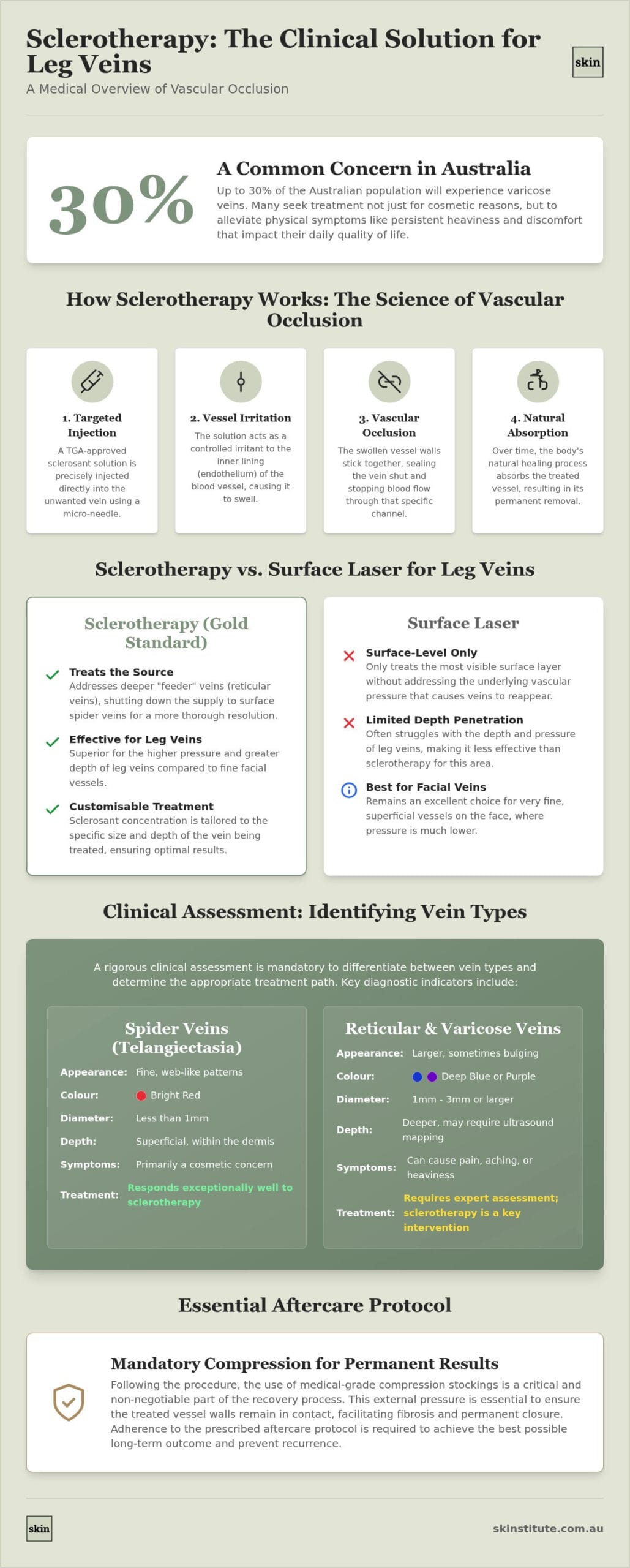
Sclerotherapy is a medical procedure involving the targeted injection of a sclerosant to induce vessel closure. Within the clinical landscape of sclerotherapy melbourne, this technique remains the gold standard for the treatment of superficial leg veins. Unlike surface-level cosmetic fixes, it’s a deep-reaching biological intervention that addresses the physical structure of the vessel itself.
The process relies on The Science of Vascular Occlusion, where a chemical solution is introduced directly into the lumen of the diseased vein. This solution acts as a controlled irritant to the endothelium, which is the inner lining of the blood vessel. When the sclerosant contacts this lining, it causes immediate cellular damage, leading to the vessel walls sticking together. This effectively stops the blood flow through that specific channel.
Once the vessel is sealed, the body initiates a natural healing response. The treated vein undergoes fibrosis, a process where it’s replaced by a small cord of connective tissue. Over time, the body’s lymphatic system reabsorbs this tissue, and the vein disappears. This biological reabsorption ensures that the results are not just temporary, but represent a permanent removal of the dysfunctional vessel from the circulatory path.
The Role of the Sclerosant Solution
The efficacy of the treatment depends heavily on the chemical properties of the sclerosant used. In a medical-grade environment, practitioners select TGA-approved agents that have been refined over decades for safety and predictability. The concentration of these solutions is never static. Instead, it’s tailored to the specific diameter of the vein being treated. Finer telangiectasias require a low concentration, while larger reticular veins demand a higher strength to ensure successful occlusion. This customisation is vital for achieving a clear outcome while minimising the risk of skin staining or irritation.
Why Sclerotherapy Over Laser for Leg Veins?
For many patients, the choice between laser and injections is a point of confusion. While surface lasers are excellent for very fine facial vessels, they often struggle with the higher pressure and greater depth of leg veins. Sclerotherapy is superior because it allows the practitioner to address “feeder” veins at their source. By injecting the sclerosant directly into these reticular veins, we shut down the supply to the smaller spider veins on the surface. This method provides a more thorough resolution than laser, which only treats the most visible surface layer without addressing the underlying vascular pressure that causes veins to reappear.
Clinical Assessment: Spider Veins vs. Varicose Veins
Before initiating any treatment, a rigorous clinical assessment is mandatory to determine the physiological nature of the vascularity. In the context of sclerotherapy melbourne, this diagnostic phase ensures the procedure is applied only to suitable candidates, maintaining the high standards of safety expected in a medical-grade environment. A practitioner must evaluate specific visual and physical markers to differentiate between purely aesthetic concerns and underlying venous disease.
Diagnostic indicators typically include:
- Colour: Bright red vessels often indicate superficial telangiectasia, while deep blue or purple hues suggest larger reticular involvement.
- Diameter: Vessels measuring less than 1mm are generally classified as spider veins, whereas those between 1mm and 3mm are considered reticular.
- Depth: Superficial vessels sit within the dermis, while deeper vessels may require transillumination or ultrasound to map their path accurately.
Patients considering The Sclerotherapy Procedure must understand that successful outcomes rely on identifying the source of the visible vascularity. A thorough clinical consultation remains the only way to accurately map these vessels and ensure the correct sclerosant concentration is utilised.
Spider Veins (Telangiectasia)
Telangiectasia, commonly known as spider veins, are fine, web-like patterns that appear near the skin surface. In the Australian climate, prolonged sun exposure and lifestyle factors can exacerbate their appearance, leading to significant self-consciousness. These vessels are purely aesthetic in nature and don’t typically cause physical pain. Because they’re situated so close to the surface, they respond exceptionally well to microsclerotherapy, often achieving high clearance rates after a structured course of treatment.
Reticular and Varicose Veins
Reticular veins act as the “feeder” vessels for spider vein clusters. They’re often flatter and blue, sitting slightly deeper in the skin. Treating these is essential because failing to close the feeder vein often leads to the rapid recurrence of spider veins. However, a clear boundary exists where sclerotherapy stops being the appropriate tool. If a vein is bulging, twisted, or indicates significant valvular incompetence (venous reflux), it’s classified as a varicose vein. These larger vessels often require surgical referral or endovenous thermal ablation, as the high pressure within the vessel can prevent a sclerosant from effectively sealing the lumen. Recognising this limit is a hallmark of a professional clinical practice.
The Sclerotherapy Procedure at Skinstitute Melbourne
Following a successful clinical assessment, the procedure begins with precise skin preparation. In a professional sclerotherapy melbourne clinic, this involves cleansing the target area with a medical-grade antiseptic and identifying the specific entry points for the sclerosant solution. The practitioner marks the vessels while the patient is standing, as gravity makes the veins more prominent and easier to target with accuracy.
The practitioner utilises ultra-fine, short-gauge needles specifically designed for microsclerotherapy. These instruments ensure that the sclerosant is delivered with high technical accuracy into the vessel lumen while minimising patient discomfort. This approach is rooted in The Science of Vascular Occlusion, where the primary objective is to displace blood and irritate the vessel wall without causing trauma to the surrounding dermal tissue.
A typical session lasts between 30 and 45 minutes, depending on the extent of the vascularity. During this time, the practitioner may perform dozens of micro-injections to cover the entire network of spider and reticular veins. Immediately after the injection, the vein will often “blanch” or turn white as the solution displaces the blood. This is followed by localised redness and a mild inflammatory response, which is a normal clinical indicator that the biological mechanism of occlusion has been successfully triggered.
Patient Comfort and Technical Precision
Maintaining patient comfort is a priority. Most individuals describe the sensation as a minor stinging or a “mosquito bite” feeling that subsides quickly. To ensure total coverage and precision, we utilise high-intensity polarised lighting and medical-grade magnification. This specialised equipment allows us to visualise fine telangiectasias that aren’t always apparent to the naked eye, ensuring a methodical and thorough treatment of the entire leg area.
Treatment Frequency and Planning
While some vessels respond to a single injection, most patients require a series of two to four sessions to achieve optimal clearance. We typically schedule these appointments at four to six week intervals. This timeframe is necessary to allow the initial inflammatory response to subside and to monitor the biological reabsorption of the treated vessels. Drawing on 26 years of industry experience, we develop a personalised plan that accounts for your specific vascular density and the body’s natural healing rate.
Clinical Aftercare and Recovery in the Melbourne Climate
The post-procedural phase of sclerotherapy melbourne is as critical to the final result as the technical precision of the injections themselves. Once the sclerosant has successfully irritated the vessel lining, the body requires a controlled environment to facilitate the permanent fusion of the vein walls. Patient compliance with aftercare protocols ensures that the inflammatory response leads to successful fibrosis rather than the vessel simply reopening under internal pressure.
Immediately following the session, you’ll be instructed to walk for 20 to 30 minutes. This activity is vital as it promotes healthy blood flow through the deep venous system, ensuring the sclerosant remains localised in the superficial target vessels. While you can return to most daily activities immediately, intense lower-body exercise or heavy lifting should be avoided for approximately seven days to prevent a sudden spike in venous pressure. Medical-grade compression stockings must be worn continuously for the first 72 hours and then during daylight hours for a further 11 days to maintain vessel closure and prevent the risk of recanalisation.
It’s normal to experience minor bruising or small, firm areas along the path of the treated vein. These firm spots, often referred to as “trapped blood,” occur when a small amount of blood becomes sequestered within the sealing vessel. During your follow-up appointment, these areas can be managed through a simple clinical expression, which prevents the long-term risk of haemosiderin staining or “iron-shadowing” on the skin.
Compression Therapy Protocol
Compression therapy provides the external pressure necessary to keep the irritated endothelium adhered while the body converts the vessel into a fibrotic cord. In Melbourne’s climate, particularly during warmer periods, wearing heavy stockings can feel restrictive. We recommend selecting high-quality, breathable garments and applying a light moisturiser to the skin to reduce friction. During the first three days, the stockings should only be removed for brief, cool showers to ensure the initial seal remains undisturbed.
Sun Protection and Pigmentation Management
UV exposure is a significant risk factor for post-treatment pigmentation. If treated areas are exposed to the sun before the body has fully reabsorbed the iron from the treated vessels, permanent brown staining can occur. Given the high UV index in Victoria, we advise patients to avoid direct sun exposure on the legs for at least four to six weeks post-procedure. Planning your treatment during the cooler months allows you to hide the compression garments under clothing while avoiding the peak of the Melbourne beach season. Supporting the skin with medical-grade topical serums can also accelerate the resolution of minor bruising. To ensure you achieve the best possible clinical outcome, book a clinical consultation with our experienced Melbourne team to discuss a tailored recovery schedule.
Integrating Sclerotherapy with Advanced Skin Regeneration
Within our clinical framework, sclerotherapy is positioned as a foundational step in a broader strategy of rejuvenation and regeneration. Removing dysfunctional vessels isn’t merely an aesthetic choice; it’s a way to restore the visual uniformity of the skin while resolving the physical heaviness associated with superficial vascularity. When we address these veins, we clear the path for other medical-grade therapies to work more effectively on the surrounding tissue. This integrated approach ensures that the final outcome reflects a total restoration of skin health rather than just the removal of a single concern.
Leg vein removal through sclerotherapy melbourne often acts as a catalyst for further body treatments. For instance, once the vascular canvas is clear, skin needling can be utilised to improve dermal thickness and elasticity in areas where the skin has become thin or sun-damaged. Choosing a clinic that houses a diverse suite of medical-grade technologies allows for this level of sophisticated planning. With 26 years of specialised experience in Melbourne, we understand that the best results come from a methodical sequence of treatments that respect the body’s natural healing cycles and biological limits.
The Skinstitute Advantage
Our clinical environment prioritises technical mastery and safety above all else. A professional assessment by an experienced practitioner is the only way to ensure that each treatment is tailored to your specific physiological needs. We don’t believe in a one-size-fits-all approach; instead, we rely on established scientific principles to guide every injection and laser pulse. This dedication to precision is what defines our practice. For a more detailed overview of our standards and services, you can consult the Skinstitute Melbourne clinical guide to medical-grade aesthetic treatments.
Beyond Veins: A Holistic Aesthetic Journey
A truly holistic journey often extends beyond the vascular system to address the overall quality of the skin. Complementary treatments like Fractional CO2 Laser resurfacing can be integrated to resolve pigmentation issues or surface irregularities that sclerotherapy alone cannot fix. Furthermore, the introduction of Rejuran and other polynucleotide bio-stimulators represents a significant advancement in skin health, allowing us to encourage cellular repair and biostimulation from within the dermis. These technologies represent the future of regenerative medicine, offering a path to resilient, healthy skin that maintains its integrity over time. To begin your own structured treatment journey, we invite you to book a clinical analysis for a tailored plan designed by our expert team.
Achieving Lasting Vascular Clarity and Skin Health
For those seeking to enhance their recovery and overall well-being alongside their clinical treatments, City Cave Clyde North provides a range of wellness services, including float therapy and infrared saunas, to support a holistic lifestyle.
Successful leg vein removal is a methodical process that transitions from rigorous diagnostic assessment to the precise biological occlusion of dysfunctional vessels. The permanence of your results depends on the technical mastery of the practitioner and your adherence to specialised clinical aftercare protocols, particularly regarding compression and UV protection. By addressing the underlying reticular feeders alongside superficial spider veins, it’s possible to restore both the aesthetic evenness and physical lightness of the lower limbs.
When seeking sclerotherapy melbourne, the value of experience cannot be overstated. Our clinic offers over 26 years of medical aesthetic experience, providing a grounded and professional environment led by experienced Melbourne-based practitioners. We view vascular health as a vital component of your broader skin regeneration journey, prioritising safety and evidence-based outcomes at every stage. We invite you to Book Your Clinical Vein Assessment at Skinstitute Melbourne to begin a structured analysis of your vascular needs. We look forward to guiding you toward a clear and revitalised clinical outcome.
Frequently Asked Questions
Is sclerotherapy painful?
Most patients describe the sensation as a series of minor stings or mosquito bites that resolve quickly. The ultra-fine gauge needles used in a medical-grade environment are designed to minimise dermal trauma. While you might feel a slight burning sensation as the sclerosant contacts the vessel lining, this is temporary. We prioritise patient comfort by utilising precise techniques and magnification, ensuring the procedure remains highly tolerable without the need for local anaesthesia.
How many sclerotherapy sessions will I need?
While some superficial vessels respond to a single treatment, most patients require two to four sessions for optimal clearance. The number of sessions depends on the density and diameter of the vascular network being addressed. Each session is typically spaced four to six weeks apart, allowing the body sufficient time to begin the biological reabsorption of the treated vessels. During your initial clinical assessment, we develop a personalised plan based on our 26 years of industry experience.
Can I walk or exercise immediately after sclerotherapy?
Walking immediately after your session is a non-negotiable part of the clinical protocol to promote healthy deep venous circulation. You’re encouraged to maintain light daily activity, but vigorous lower-body exercise or heavy lifting must be avoided for at least seven days. High-impact movements can increase venous pressure and potentially interfere with the successful occlusion of the treated vessels. Maintaining a steady walking routine helps ensure the sclerosant remains effective within the targeted superficial veins.
Are the results of sclerotherapy permanent?
The destruction of the treated vessel is permanent, as the body replaces the occluded vein with fibrotic tissue that is eventually reabsorbed. However, sclerotherapy doesn’t prevent the formation of new spider veins in the future. Predisposing factors such as genetics, hormonal changes, and lifestyle continue to influence your vascular health. Periodic maintenance or integrated skin regeneration treatments can help manage new vessels if they appear over time, ensuring long-term aesthetic clarity on the legs.
Will sclerotherapy work on my face or just my legs?
Sclerotherapy is primarily the gold standard for leg veins, where vessels are often deeper and under higher pressure. For facial vascularity, such as fine telangiectasia around the nose or cheeks, we typically recommend laser-based technologies or other specialised modalities. Facial skin is thinner and has different circulatory characteristics, meaning the risks of pigmentation or skin irritation are higher with sclerosants. Our practitioners assess each area to determine which medical-grade technology provides the safest and most effective outcome.
What are the risks or side effects of sclerotherapy?
Common clinical side effects include localised bruising, redness, and minor swelling at the injection sites. Some patients may notice small, firm areas of “trapped blood” or temporary pigmentation known as haemosiderin staining, which usually resolves as the body heals. While rare, more significant risks include skin ulceration or allergic reactions to the sclerosant. Our specialised clinical aftercare protocols and extensive experience are designed to mitigate these risks and ensure a safe, predictable recovery process for every patient.
How much does sclerotherapy cost in Melbourne?
The cost of sclerotherapy melbourne varies significantly depending on the complexity of the vascular network and the number of vials of sclerosant required. Because every patient presents with a unique vascular profile, a precise quote is only provided following a thorough clinical assessment. Factors influencing the total investment include the duration of the session and whether multiple appointments are necessary for full clearance. We focus on providing a transparent, medical-grade service that prioritises long-term results over quick, surface-level fixes.
When is the best time of year to have sclerotherapy?
The cooler months in Victoria are generally considered the ideal time to undergo this procedure. This timing is advantageous because medical-grade compression stockings, which are mandatory for successful occlusion, are more comfortable to wear in lower temperatures. Additionally, treated areas must be strictly protected from UV exposure to prevent post-inflammatory pigmentation. By scheduling treatment during autumn or winter, you can ensure your legs have fully healed and the vessels have reabsorbed before the peak Melbourne beach season.