PDO Threads vs HIFU Melbourne: A Clinical Guide to Non-Surgical Lifting in 2026
August 1, 2026
Clinical Guide to Non-Surgical Cosmetic Procedures in Melbourne: Science-Led Skin Regeneration
August 3, 2026The skin you’re in today is not the same skin you had a decade ago, and that’s not simply a matter of appearance. Collagen and elastin, the structural proteins responsible for skin firmness and resilience, decline progressively with age, resulting in laxity, fine lines, and a loss of the skin’s natural contour. If you’ve been researching your options and found yourself overwhelmed by a seemingly endless list of devices, techniques, and clinical claims, you’re not alone.
It’s a common frustration: the more you search for the right skin tightening treatment, the more conflicting information you encounter. Questions around safety, downtime, and whether non-invasive options can genuinely deliver meaningful results are entirely reasonable, and they deserve clear, honest answers rather than marketing promises.
This guide is designed to cut through the noise. Drawing on established aesthetic science and clinical practice, it will walk you through how modern skin tightening treatments work at a biological level, what the leading non-invasive modalities involve, and how to evaluate which approach is best suited to your skin’s specific needs. By the end, you’ll have the foundational knowledge to approach a consultation with confidence and realistic expectations.
Key Takeaways
- Collagen and elastin loss is the primary biological driver of skin laxity, and understanding this mechanism is essential to selecting a skin tightening treatment that addresses the root cause rather than surface symptoms.
- Leading non-invasive modalities — including HIFU, PDO thread lifting, and fractional CO2 — each work through distinct physiological mechanisms, meaning the most effective option depends on your skin’s specific condition and treatment goals.
- A thorough initial consultation is a critical step in the treatment process, establishing a personalised protocol and ensuring realistic expectations around results, downtime, and aftercare requirements.
- Post-treatment recovery varies considerably between modalities, and adhering to evidence-based aftercare practices plays a direct role in optimising and prolonging your clinical outcomes.
- Practitioner expertise and medical-grade technology are key differentiating factors when evaluating clinics, as the precision and safety of delivery directly influence both the efficacy and the risk profile of your treatment.
Understanding Skin Tightening Treatments
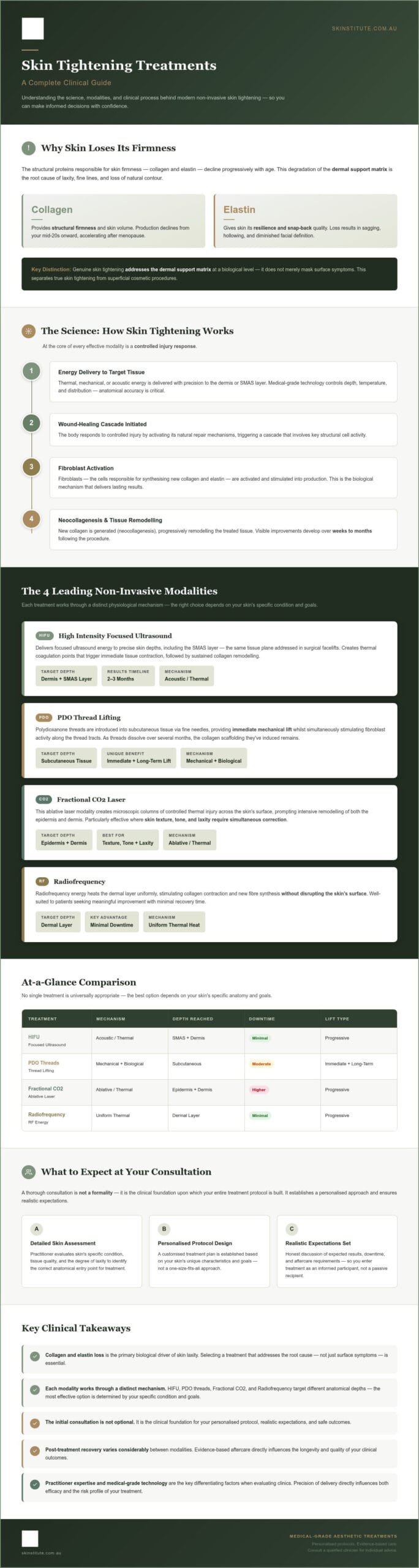
Skin tightening, as a clinical category, refers to any procedure designed to restore structural integrity to tissue that has lost firmness due to intrinsic ageing, environmental exposure, or volume displacement. Unlike surface-level interventions that address pigmentation or texture alone, a skin tightening treatment targets the deeper architectural layers of the skin, stimulating biological repair mechanisms that produce measurable, progressive improvements in tone and contour.
The importance of this distinction is considerable. Many individuals seek treatment for concerns they describe as “sagging,” “hollowing,” or a general loss of definition, without realising that these presentations share a common underlying cause: the degradation of the dermal support matrix. Addressing that matrix, rather than masking its decline, is what separates genuine skin tightening from superficial cosmetic procedures.
The Science Behind Skin Tightening
At the core of every effective skin tightening modality is a controlled injury response. When targeted thermal, mechanical, or acoustic energy is delivered to the dermis or the superficial musculoaponeurotic system (SMAS) beneath it, the body initiates a wound-healing cascade. This cascade involves fibroblast activation, the cells responsible for synthesising new collagen and elastin fibres. The resulting neocollagenesis, meaning the generation of new collagen, progressively remodels the treated tissue over weeks to months following the procedure.
The precision with which modern technology delivers energy to a specific tissue depth is what distinguishes clinical treatments from consumer-grade devices. Controlling the depth, temperature, and distribution of energy determines whether the treatment stimulates the correct biological response without causing collateral damage to surrounding structures. This is where the role of medical-grade technology becomes critical: it’s not simply about applying heat or ultrasound, but about delivering it with anatomical accuracy.
Common Skin Tightening Procedures
The leading non-invasive modalities each operate through distinct physiological mechanisms, which is why no single treatment is universally appropriate.
- High Intensity Focused Ultrasound (HIFU): HIFU delivers focused ultrasound energy to precise depths within the skin, including the SMAS layer typically addressed in surgical facelifts. The thermal coagulation points created at these depths trigger an immediate tissue contraction followed by a sustained collagen remodelling response over two to three months.
- PDO Thread Lifting: Polydioxanone (PDO) threads are introduced into the subcutaneous tissue via fine needles, providing immediate mechanical lift while simultaneously stimulating fibroblast activity along the thread tracts. As the threads dissolve over several months, the collagen scaffolding they’ve induced remains.
- Fractional CO2: This ablative laser modality creates microscopic columns of controlled thermal injury across the skin’s surface, prompting intensive remodelling of both the epidermis and dermis. It’s particularly effective where skin texture, tone, and laxity require simultaneous correction.
- Radiofrequency: Radiofrequency energy heats the dermal layer uniformly, stimulating collagen contraction and new fibre synthesis without disrupting the skin’s surface, making it suited to patients seeking improvement with minimal recovery.
Each of these approaches addresses skin laxity from a different anatomical entry point, which is precisely why a thorough clinical assessment is the necessary first step before any treatment protocol is established.
What to Expect During a Skin Tightening Treatment
For many people, uncertainty about the process itself is the primary barrier to seeking treatment. Understanding what actually happens, from the first appointment through to the procedure itself, removes much of that hesitation and allows you to engage with your clinician as an informed participant rather than a passive recipient.
Initial Consultation and Assessment
A thorough consultation is not a formality; it’s the clinical foundation upon which your entire treatment protocol is built. During this appointment, your practitioner will conduct a detailed assessment of your skin’s condition, examining tissue laxity, dermal thickness, and the degree of volume displacement present. This evaluation goes well beyond a visual inspection, incorporating palpation of the tissue and, in some cases, photographic documentation to establish a baseline for measuring outcomes.
Your medical history is equally important to this process. Certain conditions, medications, and prior cosmetic interventions can influence both the suitability of a given modality and the parameters used during treatment. A responsible clinician will ask specifically about:
- Any history of autoimmune conditions or active skin infections in the treatment area
- Current use of anticoagulants, retinoids, or immunosuppressive medications
- Previous surgical procedures, injectables, or energy-based treatments in the same region
- Pregnancy or breastfeeding status
Equally, this is your opportunity to articulate your expectations clearly. Practitioners experienced in aesthetic medicine understand that a patient’s perception of their concern doesn’t always align precisely with the clinical presentation, and bridging that gap during consultation is essential to achieving a satisfying outcome. Clinics like Skinstitute, with over two decades of practice in advanced aesthetic treatments, approach this assessment phase as a genuine clinical dialogue rather than a preliminary sales step.
During the Treatment
The procedural experience varies depending on the modality selected, though most non-invasive skin tightening treatments follow a broadly consistent structure. The treatment area is first thoroughly cleansed, and a coupling gel or topical anaesthetic may be applied depending on the device and the patient’s sensitivity threshold.
HIFU sessions, for instance, typically involve the systematic application of a handheld transducer across mapped treatment zones, with each pass delivering focused ultrasound energy to a pre-determined tissue depth. Patients commonly describe the sensation as intermittent prickling or a deep, brief warmth beneath the skin’s surface. PDO thread procedures involve the precise insertion of fine cannulas or needles, with mild pressure and occasional tugging sensations during thread placement. Fractional CO2 treatments produce more pronounced heat, and topical anaesthetic is standard practice to ensure comfort throughout.
Session duration ranges from approximately 30 minutes for targeted radiofrequency applications to 90 minutes or more for comprehensive HIFU or thread lifting protocols. Knowing this in advance allows you to plan your day accordingly, particularly if you have professional or social commitments immediately following your appointment.
Post-Treatment Care and Recovery
The biological work of a skin tightening treatment doesn’t end when you leave the clinic. Neocollagenesis, the process of new collagen formation that underlies every modality discussed in this guide, unfolds progressively over weeks and months following your procedure. How you care for your skin during this period directly influences the quality and longevity of your results.
Immediate Post-Treatment Care
In the first 24 to 72 hours after treatment, the skin’s primary need is protection and hydration. The treated tissue is in an active inflammatory phase, which is a necessary and expected part of the healing cascade, but it’s also a period of heightened sensitivity. Applying a gentle, fragrance-free moisturiser helps support the skin barrier without introducing potential irritants. Avoid active ingredients, including retinoids, alpha hydroxy acids, and vitamin C serums, until your clinician confirms the skin has adequately recovered.
Sun avoidance is non-negotiable during this window. UV exposure on recently treated skin can compromise the remodelling response and increase the risk of post-inflammatory hyperpigmentation, particularly in individuals with medium to deeper skin tones. If you must go outdoors, a broad-spectrum SPF 50+ sunscreen applied generously is the minimum standard. Strenuous physical activity, saunas, and steam rooms should also be avoided for at least 48 hours, as elevated core temperature and perspiration can exacerbate swelling and prolong redness in the treatment area.
Modality-specific responses vary. Following PDO thread lifting, mild bruising, swelling, and a sensation of tightness along the thread tracts are common and typically resolve within five to seven days. HIFU patients often experience transient redness and subtle oedema that subsides within hours to a day. Fractional CO2, being the most ablative of the modalities, involves a more pronounced recovery: expect redness, peeling, and skin sensitivity for several days, with full surface healing typically occurring within one to two weeks. Any persistent pain, unusual warmth, or signs of infection warrant prompt contact with your treating clinic.
Long-Term Care and Maintenance
Once the skin has fully recovered, the focus shifts to preserving and extending the clinical gains. A consistent daily regimen built around broad-spectrum sun protection, a medical-grade antioxidant, and a peptide or growth factor serum supports the ongoing collagen remodelling process. Your clinician may also recommend adjunctive treatments, such as skin needling or exosome therapy, to complement and sustain the structural improvements achieved.
Results from non-invasive skin tightening continue to develop for up to three months post-treatment as collagen matures and reorganises. Scheduling a follow-up appointment at the four to six week mark allows your practitioner to assess tissue response, document progress against your baseline photographs, and determine whether a repeat session or complementary modality is warranted. Most patients benefit from a maintenance protocol involving annual or biannual treatments, tailored to the natural rate at which their skin continues to age.
Consistent follow-up is not simply a commercial consideration; it’s a clinical one. Tissue changes are cumulative, and the relationship between patient and practitioner over time allows for increasingly refined and personalised treatment decisions.
Comparing Skin Tightening Treatments
Choosing between the available modalities is rarely straightforward, because each addresses skin laxity through a fundamentally different mechanism and at a different anatomical depth. A meaningful comparison requires looking beyond marketing language and examining what each approach actually does to tissue, who it’s best suited to, and what the realistic recovery and outcome trajectory looks like.
HIFU vs PDO Thread Lifting
These two modalities are frequently positioned as alternatives to one another, but they’re more accurately understood as complementary options suited to different presentations of tissue laxity.
HIFU operates without any physical insertion into the skin. Focused ultrasound energy is delivered transcutaneously to precise depths, including the SMAS layer, triggering thermal coagulation points that initiate a collagen remodelling response over the following two to three months. There’s no wound, no thread, and no recovery period of significance. The trade-off is that results are gradual and cumulative; patients with moderate to significant laxity may find the lifting effect more subtle than they’d hoped from a single session.
PDO thread lifting, by contrast, delivers an immediate mechanical repositioning of tissue alongside its biological stimulus. Because threads physically reposition the soft tissue, patients with more pronounced jowling or mid-face descent often see a more immediately visible result. The procedure does involve insertion, which means mild bruising, localised swelling, and a short period of restricted facial movement are realistic expectations. Results typically persist for twelve to eighteen months as the collagen scaffolding matures.
In terms of ideal candidacy, HIFU tends to suit individuals in their late thirties to early fifties with mild to moderate laxity who prefer a zero-downtime experience. PDO threading is frequently more appropriate where there’s visible structural displacement requiring a repositioning effect rather than purely a tightening one.
Fractional CO2 vs Non-Invasive Options
Fractional CO2 occupies a distinct position in any skin tightening treatment comparison because it operates at the surface as well as within the dermis. By creating controlled columns of ablative thermal injury across the skin, it simultaneously addresses texture irregularities, pigmentation, and dermal laxity in a single protocol. This makes it particularly well-suited to patients whose concerns include both structural and surface-level deterioration, typically from the mid-forties onward when photoageing compounds intrinsic collagen loss.
The meaningful difference lies in recovery. Non-invasive options such as HIFU and radiofrequency allow patients to return to normal activity almost immediately. Fractional CO2 involves visible peeling, redness, and sensitivity for several days, with full surface healing taking up to two weeks. For patients who can accommodate that downtime, the depth and comprehensiveness of the remodelling response is considerably greater than what non-ablative modalities achieve in a single session.
- HIFU: Best for mild to moderate laxity; no downtime; results develop gradually over two to three months
- PDO Thread Lifting: Best where visible repositioning is required; minor downtime of five to seven days; immediate and progressive results
- Fractional CO2: Best where surface concerns accompany laxity; recovery of one to two weeks; comprehensive remodelling of both epidermis and dermis
None of these modalities is universally superior. The most effective choice is always the one that aligns with your specific tissue presentation, age-related changes, lifestyle, and tolerance for recovery. A thorough clinical assessment is the only reliable basis for that determination. Book a consultation with Skinstitute to receive a personalised treatment recommendation grounded in over two decades of advanced aesthetic practice.
Why Choose Skinstitute for Your Skin Tightening Treatment
Expertise and Experience
Over two decades of practice in advanced aesthetic medicine produces a quality of clinical judgement that simply cannot be replicated in newer facilities. Skinstitute’s practitioners bring extensive training in energy-based and minimally invasive modalities, including HIFU, PDO thread lifting, fractional CO2, and skin needling. This breadth of expertise matters because it allows the treating clinician to select and combine modalities based on what the tissue actually requires, rather than defaulting to a single approach. In Melbourne’s competitive aesthetic landscape, that depth of experience is a meaningful differentiator.
Choosing a certified aesthetic clinic also carries a safety dimension that’s easy to underestimate. Medical-grade devices operated by trained clinicians deliver energy within anatomically precise parameters. The risk profile of any skin tightening treatment is directly shaped by who is operating the equipment and how thoroughly they’ve assessed your tissue before beginning.
Client-Centric Approach
Skinstitute’s treatment philosophy begins with the understanding that no two patients present identically. The degree of laxity, the anatomical distribution of volume loss, skin tone, and prior treatment history all inform which protocol is most appropriate. Rather than offering fixed treatment packages, the clinic develops individualised plans that reflect each patient’s specific clinical presentation and realistic goals.
Post-treatment support is treated as an integral part of the clinical process, not an afterthought. Follow-up appointments allow practitioners to assess tissue response against baseline documentation, refine ongoing recommendations, and determine whether adjunctive treatments such as exosomes or Rejuran would further support the remodelling process. This continuity of care is what allows outcomes to be progressively optimised over time.
Patient education is woven into every stage of the experience. From the initial consultation through to long-term maintenance planning, Skinstitute’s practitioners take the time to explain the biological rationale behind each recommendation, ensuring you understand not just what is being done, but why. That transparency is the foundation of a clinical relationship built on trust rather than assumption.
If you’re ready to move from research to action, book a consultation with Skinstitute and receive a personalised assessment from practitioners with over two decades of advanced aesthetic experience.
Take the Next Step Towards Firmer, More Resilient Skin
Understanding the biology behind skin laxity, and the clinical mechanisms that address it, puts you in a fundamentally stronger position when it comes to making treatment decisions. The key insight this guide reinforces is that meaningful skin tightening treatment works at the level of tissue architecture, not surface appearance, and that selecting the right modality depends entirely on an accurate assessment of your individual presentation.
Whether your concerns point toward HIFU, PDO thread lifting, fractional CO2, or a combination protocol, the quality of your outcome is shaped directly by the expertise guiding those decisions. Skinstitute brings over 26 years of advanced aesthetic practice to every consultation, delivering medical-grade treatments tailored to each patient’s specific clinical needs, with a consistent record of positive outcomes built on evidence-based principles.
The most productive next step isn’t more research; it’s a conversation with a clinician who can assess your skin directly. Book your consultation with Skinstitute today and receive a personalised treatment plan grounded in genuine clinical expertise.
Frequently Asked Questions About Skin Tightening Treatments
What is skin tightening treatment and how does it work?
A skin tightening treatment is a clinical procedure designed to restore firmness and structural integrity to tissue that has lost elasticity due to ageing or environmental exposure. Each modality achieves this by delivering controlled energy, whether ultrasound, laser, or radiofrequency, to specific tissue depths, triggering a wound-healing response that activates fibroblasts. These cells synthesise new collagen and elastin, progressively remodelling the treated area over weeks to months following the procedure.
Are skin tightening treatments safe?
When performed by trained clinicians using medical-grade technology, skin tightening treatments carry a well-established safety profile. The key variable is the precision of energy delivery; anatomically accurate treatment parameters minimise the risk of collateral tissue damage. Certain contraindications, including active skin infections, specific autoimmune conditions, and particular medications, do apply, which is why a thorough pre-treatment assessment is a clinical necessity rather than an optional step.
How many sessions will I need for optimal results?
The number of sessions required depends on the modality selected, the degree of tissue laxity present, and your individual biological response to treatment. Some patients achieve satisfying outcomes from a single HIFU session, while others with more advanced laxity benefit from a staged protocol or a combination of modalities. Your clinician will establish a personalised treatment plan following a direct assessment of your tissue, rather than applying a generic session count.
What should I avoid after a skin tightening treatment?
In the 48 to 72 hours following treatment, avoid direct sun exposure, strenuous physical activity, saunas, and steam rooms, as elevated skin temperature can exacerbate swelling and prolong recovery. Active skincare ingredients such as retinoids and alpha hydroxy acids should be paused until your clinician confirms the skin has adequately healed. Broad-spectrum SPF 50+ sunscreen is non-negotiable during outdoor exposure throughout the recovery period.
Can skin tightening treatments be combined with other procedures?
Yes, and combination protocols are frequently more effective than single-modality approaches for patients with multiple concurrent concerns. HIFU targeting deeper structural laxity, for instance, can complement skin needling or exosome therapy to support surface-level remodelling and recovery. Rejuran is another adjunctive option that some practitioners incorporate to enhance dermal repair; for those also managing specific regional concerns like dark circles, you can visit Medrein Health & Aesthetics to learn about treating ‘panda eyes’. Your clinician will determine which combinations are appropriate based on your tissue presentation and treatment timeline.
How long do the results of skin tightening last?
Results vary by modality and individual rate of ageing, but most patients can expect meaningful improvements to persist for twelve to twenty-four months following treatment. PDO thread lifting typically maintains its lifting effect for twelve to eighteen months as the induced collagen scaffolding matures. HIFU results develop over two to three months post-treatment and are similarly sustained. Ongoing collagen loss due to intrinsic ageing means that annual or biannual maintenance sessions are generally recommended to preserve outcomes over time.
What are the costs associated with skin tightening treatments?
Treatment costs in Australia vary considerably depending on the modality, the size of the treatment area, the number of sessions required, and the clinical expertise of the practitioner. Rather than quoting figures that may not reflect your specific protocol, we’d encourage you to request a detailed cost breakdown during your consultation, where your clinician can outline a personalised plan with transparent pricing. Choosing a clinic based on cost alone carries genuine clinical risk; practitioner experience and device quality are equally important considerations.